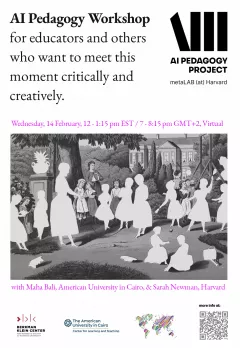
Sarah Newman is a researcher, educator, and creative leader working at the intersection of AI, ethics, and education.
As the Director of Art & Education at Harvard’s metaLAB within the Berkman Klein Center for Internet & Society, she leads an interdisciplinary portfolio that brings critical, human-centered perspectives into conversations about emerging technologies. She also holds an appointment as an Assistant Professor of Education at Western Norway University, where she is helping design and teach courses on AI for teacher education. Her work broadly asks how AI systems both shape and are shaped by our values, institutions, and everyday experiences.
She is the Founder & Project Lead of the AI Pedagogy Project–a widely used public resource that helps educators engage AI thoughtfully and responsibly in their teaching. Since launching in 2023, the project has reached over 200,000 people worldwide and is used and cited by institutions of higher education, public interest organizations, and governmental bodies. Newman also co-founded the Data Nutrition Project, a nonprofit initiative focused on improving transparency and equity in data-driven systems, and more recently launched the Public AI Summit, a free, online event designed to make AI knowledge accessible to broad public audiences.
Across her work, Newman combines collaborative research, curriculum design, and public programming to create spaces where people can critically and creatively engage with technology. Trained in philosophy and imaging arts (BA, Washington University in St. Louis; MFA, Rochester Institute of Technology), her focus remains on building practical tools and inclusive learning experiences for a rapidly changing technological landscape. Previous honors include: Harvard Assembly Fellow, Harvard Berkman Klein Fellow, Rockefeller Foundation Bellagio AI Resident, Artist-in-Residence at Northeastern School of Law, Notre Dame Tech Ethics grant recipient, National Endowment of the Arts grant recipient, and winner of the Ars Electronica Award for Digital Humanity.