Skip to the main content

Prof. Virgilio Almeida’s research centers on algorithmic and digital governance, social computing, artificial intelligence (AI), and ethics. His work bridges theory and practice, examining how algorithmic systems reshape institutions and impact society. 

He is the author of Governance for the Digital World (2020) and Algorithmic Institutionalism (2023), the latter of which argues for the democratization of algorithmic power. In addition to his focus on digital governance, Prof. Almeida is a recognized authority in computing systems performance. His influential book Capacity Planning for Web Performance (1989) has been adopted in graduate programs worldwide and translated into multiple languages. His current research combines theoretical analysis of institutional change with empirical studies on platform governance and the societal impacts of algorithms. On the theoretical side, he integrates political science and computer science to develop the concept of algorithmic institutions, particularly in the context of AI agent governance. On the empirical side, his work focuses on the role of large language models (LLMs) in shaping public discourse—especially how LLMs represent and disseminate information about global challenges such as education and climate change. Beyond academia, Prof. Almeida is active in public science communication and interdisciplinary collaboration. His columns in national media explore digital governance, AI ethics, and the broader societal consequences of digital transformation.

Publications

Publication
Nov 20, 2017

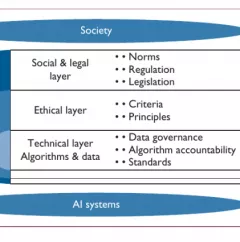
A Layered Model for AI Governance

​AI-based systems are “black boxes,” resulting in massive information asymmetries between the developers of such systems and consumers and policymakers.

Community

Tech Policy Press

AI Regulation Versus AI Innovation

A Fake Dichotomy

Virgilio Almeida and coauthors explore the (false) tension between regulation and innovation, arguing that democratic regulation can ensure that citizens have a role in shaping…

Apr 18, 2025
arXiv

Analyzing Political Discourse on Discord during the 2024 U.S. Presidential Election

"Social media networks have amplified the reach of social and political movements, but most research focuses on mainstream platforms such as X, Reddit, and Facebook, overlooking…

Feb 13, 2025
arXiv

Analyzing Political Discourse on Discord during the 2024 U.S. Presidential Election

Faculty Associate Virgilio Almeida and coauthors analyzed over 30 million political messages on Discord during the 2024 US election.

Feb 5, 2025
Communications of the ACM

Thinking of Algorithms as Institutions

A route to democratic digital governance.

Virgilio Almeida and coauthors, argue that recommendation algorithms can and should be governed democratically.

Dec 17, 2024
Oxford University Press

Algorithmic Institutionalism

In a new Oxford University Press book, Virgilio Almeida delves into the increasing presence of algorithms in everyday decisions, exploring their social and political impacts…

Dec 18, 2023
IEEE Internet Computing

Algorithms and Institutions: How Social Sciences Can Contribute to Governance of Algorithms

Virgílio Almeida takes a look at the relationship between algorithms and institutions. “Societies are experiencing a transition in which automation increases its role in daily…

Apr 1, 2022
Communications of the ACM

Futures of Digital Governance

Urs Gasser and Virgílio Almeida take a historical look at the evolution of Internet governance to help inform the future.

Mar 1, 2022
IEEE Internet Computing

Cyber Peace and Cyber Stability: Taking the Norm Road to Stability

A discussion of norms in the governance of cyberspace.

Oct 17, 2019
ArXiv.org

Auditing Radicalization Pathways on YouTube

Research from faculty associate paints a comprehensive picture of user radicalization on YouTube

Aug 22, 2019
The New York Times

How YouTube Misinformation Resolved a WhatsApp Mystery in Brazil

WhatsApp and YouTube formed a powerful feedback loop of extremism and misinformation

Aug 15, 2019
Valor.com.br

New meanings of the term "digital inclusion"

What is the impact of digital technologies on deep-rooted Brazilian inequalities?

Jun 12, 2019