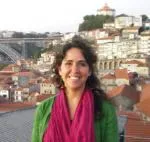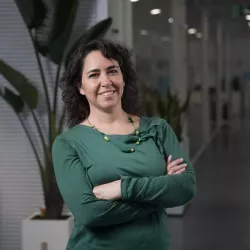
Mayo Fuster Morell is a scientist who holds Full Professor accreditation from the Catalan University Quality Assurance Agency (AQU).
Trained in economics, social and cultural anthropology, political and social sciences, and gender studies, her research over the past three decades has developed alongside the transformation of the Internet itself: from networked social movements and digital commons to the platform economy, artificial intelligence and, more recently, Open Science.
She is currently a Faculty Associate at the Berkman Klein Center for Internet & Society at Harvard University, where she has been affiliated since 2013, and Director of the Glocal Action Research Center in Barcelona. She is also faculty in the doctoral programme at Rovira i Virgili University and a member of COSMOS – The Centre on Social Movement Studies at the Scuola Normale Superiore in Florence. Concerned about the emergence of extractive and predatory models of open universities, her current research focuses on open models of Open Science, asking under which conditions openness can democratise knowledge, strengthen the public interest and enable more inclusive and sustainable systems of research and innovation, and under which conditions it can instead reproduce inequalities, corporate capture and new forms of enclosure in the name of openness. This work marks a new stage in a research trajectory that began with the governance of digital knowledge commons and now turns towards a broader question: how should science itself be opened, governed and organised in the common general interest?
Previously, a central strand of Fuster Morell’s previous research has examined the social, economic, gender and policy implications of digital transformation, particularly the expansion of the platform economy and artificial intelligence. From 2022 to 2026, she chaired COST Action – Platform Work Inclusion Living Lab (P-WILL), a pan-European network bringing together around 350 researchers and practitioners from 50 countries. P-WILL developed an intersectional and feminist approach to platform work, connecting technological transformation with gender and socioeconomic inequalities, labour conditions and public policy. She has led or held leading research roles in numerous competitive national and European projects. These include Gender Digital, addressing gender equality in the digital sphere; PLUS – Platform Labour in Urban Spaces, on platform labour and its transformation of cities; DECODE – DEcentralised Citizen-Owned Data Ecosystems, developing democratic approaches to data governance and digital sovereignty; and P2Pvalue, focused on sustainable models and value creation in commons-based peer production. She founded and led the Dimmons Research Group at the Open University of Catalonia, recognised and funded by the Government of Catalonia under 2017 SGR 1590 and 2021 SGR 01383, and previously founded IGOPnet.cc at the Autonomous University of Barcelona, dedicated to Internet, politics and the commons.
Fuster Morell’s work is characterised by an approach in which academic research, public policy and social experimentation are closely connected. Her research has informed European institutions and the Spanish and Catalan governments. She also founded and chaired the Barcelona Chair in Digital Economy, a joint initiative with Barcelona City Council and Barcelona Activa economic promotion public enterprise, and promoted the creation of an international network of cities working on collaborative and sharing-economy policies, involving cities including Seoul, Amsterdam and New York.
She completed her PhD in Social and Political Sciences at the European University Institute in Florence in 2010, with a dissertation on the governance of online creation communities and the provision of infrastructures for building digital commons. Born on the Mediterranean coast in Oliva (Valencia) in 1975, she has lived in Bilbao, London, Madrid, Amsterdam, Rome, Florence, Berkeley, and Cambridge (Boston), and now lives in a sustainable housing cooperative community in Poblenou, Barcelona. Mayo is a daughter of a generation of women who struggled to free themselves from the patriarchal violence under Franco’s dictatorship shaped by radio and television. Her own social engagement, by contrast, emerged and developed alongside the Internet itself: from the global justice movements at the turn of the millennium and the emergence of networked politics to free culture, digital commons, platform cooperativism, and digital and economic feminism.
She is the mother of Abril B, a Catalan-Italian digital-native teenager, bringing yet another generation into this personal and intellectual trajectory — one born into the Internet, rather than before it or alongside its emergence. For Mayo Fuster Morell, research is not detached from social transformation. It is a way of understanding the world in order to participate in changing it. Hope is not an option; it is an unconditional commitment to act with kindness and for the common good.