BKC Announces New Fellows for Spring 2026
New cohort joins current BKC fellows, progressing the Center’s AI research agenda
The Berkman Klein Center for Internet & Society is pleased to announce a new cohort of BKC Fellows—researchers and practitioners joining our community at a moment when the direction of AI and digital governance is being debated across academic, social, and civic sectors: in the halls of Congress, inside research labs, across industry, and throughout civil society.
The fellows build directly on the foundation laid in BKC’s 2025 Action Report, which outlines our renewed alignment around AI research, the arrival of our first Chief AI Scientist, the growth of interdisciplinary work on agentic systems, and the expansion of open-source tools designed to strengthen transparency and accountability in digital infrastructure.
“BKC is thrilled to welcome to our community this extraordinary cohort of practitioners, scholars, and builders,” said Executive Director Alex Pascal. “Hailing from different disciplines, sectors, and experiences, these fellows are grappling with urgent and profound technical, institutional, political, social, and deeply personal questions about AI—how it’s being designed; how it’s being used; how it’s being governed; and how it’s affecting people and society. We are excited to learn from them, help them learn from each other, and support their work to ensure that AI promotes human agency, dignity, and genuine connection.”
Rebecca Tabasky, the Center’s Director of Community, shared, “Traditionally, our cohort of fellows starts in the fall. But the urgency of this moment and the acceleration of technology and its implications on society demand that we bring together this amazing group of fellows now rather than later. The Center is stronger, more interesting, more fun, and more impactful when fellows are here doing this work with us, and we cannot wait to think and grow together with them.”
Across expertise and sectors, the fellows' work reflects the kind of interdisciplinary engagement that BKC elevates. The Berkman Klein Center looks forward to the research, experiments, and conversations that the work of the fellows will generate across the BKC community.
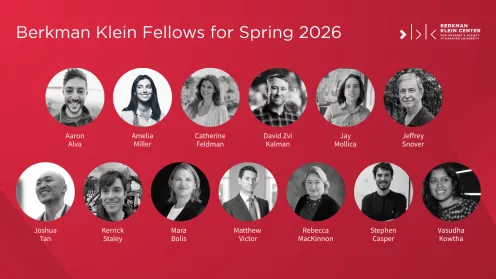
This cohort includes fellows who began their appointments this fall—Sean McGregor, Hayley Song, and Jim Cowie—as well as those joining this spring, with appointments running from March 9 through August 31.
We are excited to welcome:
 Aaron Alva
Aaron Alva is a technologist and attorney who previously served as a lead technology advisor at the FTC, where he was instrumental in shaping the agency’s approach to privacy and security enforcement. Currently he is an independent strategic advisor and expert consultant through the Alva Strategy Center. At BKC, Aaron will explore enforcement approaches—particularly for the EU AI Act—that can effectively incentivize responsible AI development.
 Mara Bolis
Mara Bolis is a women’s economic empowerment practitioner with 20 years of experience leading programs across Asia, Africa, Latin America, and the US, and a public voice on gender and AI. At BKC, Mara will investigate how generative AI is reshaping women’s lives and how they can claim their agency in response. She is the founder of First Prompt, an equitable AI adoption lab, co-host of the Womansplaining AI podcast, and author of “The AI Gender Gap Paradox” in Stanford Social Innovation Review.
 Stephen Casper
Stephen Casper (Cas) is a research stream lead for MATS, a mentor for ERA and GovAI, and a writer for the International AI Safety Report and the Singapore Consensus. His research focuses on AI safeguards and governance. While at BKC, Cas will focus on understanding and resolving technical challenges with emerging AI governance institutions and frameworks.
 Catherine Feldman
Catherine Feldman is the Executive Director and Founder of the Digital Trust Council. Her work explores how we might incentivize more responsible AI innovation rather than punish non-compliance. Informed by a decade leading product teams at Microsoft and Strategic Applied Research at Harvard’s Digital Data Design Institute, Catherine develops evidence-based standards and public infrastructure to ensure frontier AI systems are not only safer, but more aligned with human flourishing.

Isabel Hahn
Isabel Hahn is interested in exploring how privacy-preserving principles can underpin frameworks for agentic AI and what convergence across AI governance approaches reveals about possible foundations of effective agentic regulation. Isabel is based in San Francisco, where she works on AI Policy at the Delegation of the European Union to the United States.
 David Zvi Kalman
David Zvi Kalman (DZ) studies the current and historical relationship between religion and technology, with a particular focus on AI. A historian with a PhD from the University of Pennsylvania, he hosts the Belief in the Future podcast. At BKC, DZ plans to develop Jewish responses to AI through a new tech coalition and to develop a book manuscript on Jewish and other religious attempts to operate at the speed of technology.
 Vasudha Kowtha
Vasudha Kowtha is a scientist and inventor seeking to understand how emerging platforms for AI systems which personalize, such as those capable of increasingly sophisticated perception of their human users and their world, surveil our minds and influence our cognitive autonomy. As a fellow at BKC, Vasudha will explore topics in audio-based sensing, surveillance, privacy, and liability which arise from our co-adaptation with the machine intelligences we choose to share ourselves with.
 Rebecca MacKinnon
Rebecca MacKinnon is a writer, researcher, and advocate for human rights in digital environments and systems. Most recently she led global public policy advocacy for the Wikimedia Foundation. As a fellow Rebecca will be leading conversations and writing about the future of freedom and democracy in the age of AI and starting work on a sequel to her 2012 book, Consent of the Networked.
 Amelia Miller
Amelia Miller researches how technology shapes human connection. A former technology investor, she advises companies and individuals on designing healthy human-AI relationships. She holds an MSc from the Oxford Internet Institute and a BA in Social Theory and Computer Science from Harvard. As a fellow, Amelia’s work will focus on artificial intimacy literacy—helping people ensure that their relationships with machines do not erode their capacity to connect with real people—through workshops and public writing.
 Jay Mollica
Jay Mollica transforms how global cultural institutions connect with audiences through technology. For over a decade, he led digital innovation at leading US museums. Through his work at BKC, Jay hopes to develop meaningful approaches for integrating new technology in the cultural context.
 Jeffrey Snover
Jeffrey Snover is a systems philosopher and retired Technical Fellow from Microsoft and Google who invented PowerShell. Jeffrey is developing an AI Triad Rosetta Stone to map the incompatible vocabularies of AI Accelerationists, Safetyists, and Skeptics. This framework aims to resolve a systemic communication failure where these camps talk past one another, providing the infrastructure for stakeholders, journalists, and policymakers to determine whether they are actually agreeing or disagreeing.
 Kerrick Staley
Kerrick Staley’s research aims to understand how frontier AI agents can be monitored and controlled, even when they behave maliciously by accident or design. Kerrick comes from a background in machine learning research and engineering in industry, and he has made substantial contributions to the open source software ecosystem.
 Joshua Tan
Joshua Tan leads product and strategy at Public AI, a movement building AI as public infrastructure. He also leads research at Metagov, a lab for engineering institutions. At BKC, Joshua will build protocols for collaboration and peer production that help people build shared AIs.
 Matthew Victor
Matthew Victor leads digital infrastructure initiatives at Partners in Democracy, and he co-founded the Massachusetts Platform for Legislative Engagement (MAPLE), a civic platform designed to support more transparent and participatory lawmaking. Matthew develops civic platforms and governance frameworks for AI systems embedded in democratic processes, with a focus on legal and institutional models that support sustainable stewardship of digital civic infrastructure.