Inside Navigate: The Retreat That’s Redefining Digital Leadership
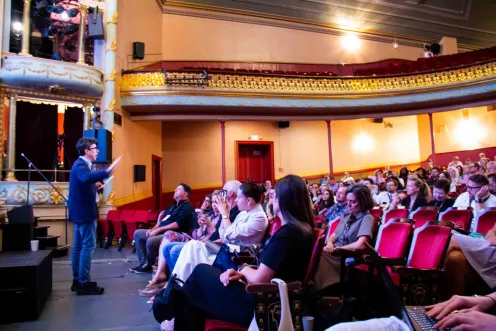
Standing on a historic stage that has hosted renowned works of art and humanity–from Dizzy Gillespie and the National Theater, to Jay Leno and Margaret Atwood–Harvard professor and co-founder of the Berkman Klein Center for Internet & Society at Harvard University (BKC) Jonathan Zittrain spoke of a new cultural force that, in many ways, has brought into question the very concept of humanity itself: Artificial Intelligence.
“AI and machine learning are becoming embedded across society without substantial reflection on their implications,” he said. “We need collaborative, honest, and technically grounded conversations. Will AI serve its users? The history of online privacy does not bode well.”
The crowd watched intently as Zittrain slowly paced the stage. "The good news is, the cavalry is coming.”
Then he stopped and faced the audience directly. “The bad news is, if you're in this audience, you're the cavalry."
Zittrain’s introduction helped set the stage for Navigate: Digital Policy Leadership Retreat in Portsmouth, New Hampshire this past June. Hosted by BKC and the IAPP, the retreat gathered global leaders across academic, government, technology, and civil society sectors to not just learn, but to grapple and collaborate with one another on society’s thorniest digital issues across AI, governance, privacy, cybersecurity, online safety, and international dynamics.
The cavalry certainly rallied, armed with tough questions and a deep well of experience. Over two days of provocative keynote sessions and dialogue-based breakouts, attendees engaged with an all-star roster of legal experts and practitioners—including BKC’s own faculty Terry Fisher and Rebecca Tushnet, and Harvard professors Jake Sullivan, Fernanda Viégas, and Martin Wattenberg—as well as voices from creative fields offering fresh perspectives to the discussions.
The crew at Navigate was extraordinary: anchored in strong shared values, scanning the horizons for the dangers and the safe ports, both, across the currents of the influencer industry, AI, cybersecurity & much more,” said Leah Plunkett, Meyer Research Lecturer on Law and BKC faculty chair of the event.
“Standing ovation for artists Alyson Stoner and Dorothy Fortenberry for bringing to life the ways that digital policy issues go beyond classrooms, courtrooms, or conference rooms to shape how we feel, how we live, and who we are and will become.”
It didn’t take much effort in these sessions to apply the concepts under discussion into real world scenarios. In one session called “Humans and Robots: Trends in AI Litigation Across the Federal Court System,” participants raised questions about a recent case in Arizona in which a judge permitted a victim impact statement to be read by an AI-generated version of the actual victim. And in the geopolitics and tech sovereignty session, BKC’s Applied Social Media Lab Fellow Rudy Fraser remarked on how relevant the conversations were to his own work in the tech space. “It covered increasing US isolationism and the push for independent tech stacks… The global appetite for community sovereignty is real.”
While it can be tempting to make sweeping generalizations pertaining to AI policy, it was evident from the diversity of opinions and experiences across sessions that there is no one-size-fits-all problem, much less solution. Jack Cushman, Director of Harvard’s Library Innovation Lab, was struck by the complexity of global AI regulations. “Professor Terry Fisher’s review of copyright regimes for AI training in a dozen countries made it clear: AI safety won’t be one solution, but a mosaic of international practices.”
Both BKC and the IAPP have deep histories of cross-sector convenings and strong, engaged communities, and each organization brought their strengths to bear in this inaugural event. “Navigate proved that this kind of collaboration is not only possible—it’s essential,” IAPP Vice President and Chief Knowledge Officer Caitlin Fennessy said. While there are still plenty of questions to address and challenges to navigate, the conversations and connections made during the retreat have potentially forged a path toward a future where humans and AI can cooperate in safe and productive ways.
The cavalry is here. And there’s plenty of room to join it.
To follow along for future events and opportunities to learn and network, sign up for BKC’s newsletter, The Buzz.