"AI and the Law" Professional Learning Program Debuts
An HLS Executive Education Collaboration
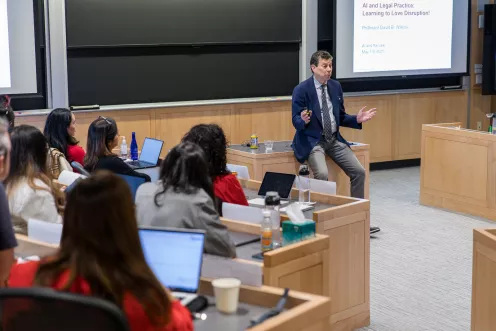
In a Harvard lecture hall that has heard countless cases debated and precedents recited, a group of 50 lawyers, government officials, and other executives sat, listening to an upbeat country-pop song. Robotic undertones streamed through the room’s PA system as the song, prompted by BKC Faculty Director Chris Bavitz, blared:
I can’t wait to learn about AI...
At the HLS AI...
Executive Education course...
The song served as the opening to a case discussion around AI in the music industry, raising questions for both lawyers and creators alike: when AI tools are used in the creative process, who is the author of the work; who owns the work; and who is liable for damages when work is unjustly copied? And furthermore, what can anyone working in these fields do to better understand and mediate the risks with the potential benefits of this technology?
These were the central concerns driving Harvard University’s Berkman Klein Center for Internet & Society (BKC) and Harvard Law School Executive Education during a recent course called “AI and the Law: Navigating the New Legal Landscape”. Over two and a half days, participants explored AI from leading experts in privacy, copyright and IP, health law, among other topics, through interactive sessions and peer exchange.
BKC Director and program chair William Fisher noted,
Many programs focus on how AI affects the ways that law firms and other legal organizations will operate and compete as AI continues to take hold of society. We wanted to focus instead on the ways that various fields of substantive law — intellectual property; health law; privacy law; torts; etc. — are rapidly changing in response to the challenges presented by AI.
Established at Harvard Law School in 1998, BKC is a pioneering institute in education related to public interest technology and the ethics of digital life. With major contributions like CopyrightX, and student programs such as Student Leaders in AI, the Center has brought its public interest focus to curious minds across the world. Harvard Law School Executive Education programs, which have been offered for legal professionals for almost 20 years, are designed to provide the knowledge and tools to address legal professionals’ biggest challenges and give them the ability to adapt and evolve with the changing legal industry. The partnership between BKC and Harvard Law School Executive Education brought together cutting-edge expertise on issues around AI and an immersive learning experience, giving participants the opportunity to critically engage with questions around this technology in ways they may not otherwise be able to in their day-to-day occupations.
“AI is being taken up in so many ways – it’s becoming as ubiquitous as asbestos, with similarly few inventories of who’s deploying it and where,” said BKC Faculty Director and Co-Founder Jonathan Zittrain, who also helped lead the program. “By taking a broad view of its implementations and limitations, along with how it might be trained and fine-tuned differently, we’ve asked participants to think about how it might be most fruitfully used.”
Participants in this most recent course hailed from a wide range of organizations and disciplines, from technology and law firms to government agencies to civil society organizations and nonprofits – all bringing with them a unique set of skills and frameworks for tackling these complex issues, as well as specific questions related to their fields. In case scenarios, participants tried on various roles, such as regulatory, legal, executive, and technologist roles in a healthcare industry lawsuit. In another case, they were charged with crisis management of a data breach caused by an agentic AI system.
Professor Bavitz also noted the importance of having such a diverse group:
What made the program so special was being able to dive deeply into legal issues around AI with people who had a command of law and regulation and came from very different backgrounds. The participants looked at risks and challenges in a variety of ways and brought their perspectives to bear on a wide range of business, legal, policy, and creative issues.
The participants’ takeaways were wide-ranging but all oriented around a thoughtful consideration of AI’s evolving role in everyday lives, organizations, and ultimately, society at large. Participants shared their appreciation not just for the structure and content of the course, but also for the opportunity to hear a spectrum of thoughts, concerns, and experiences related to the rapid evolution and adoption of AI. Some participants also expressed intrigue not only around the prevalence of AI in daily life, but also on AI’s ability to both influence and be influenced.
As BKC continues to explore new ways to engage with AI, the executive education program aims to provide even more opportunities for professionals to delve into the complexities of this technology. To learn more about the program and stay up to date on upcoming courses, be sure to follow BKC for news and updates.