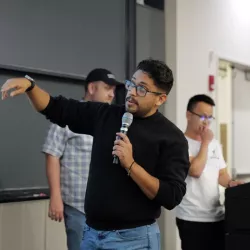
Alberto Leon is a senior software engineer doing research at Harvard's John A. Paulson School of Engineering and Applied Sciences (SEAS), focused on decentralized identity, trust infrastructure, and human agency in networked systems.
Alberto builds privacy-preserving trust systems that let people—not platforms—hold, present, and verify credentials about themselves and their relationships. His work centers on wallet-based identity architectures, Verifiable Credentials, and Verifiable Relationship Credentials (VRCs), aimed at building the trust layer the internet needs but never had. He is a lead engineer behind Keyring, an open-source identity wallet developed with the Linux Foundation's Decentralized Trust Graph Working Group that lets users store credentials on their own device and disclose only what's necessary—proving you're over 18 without revealing your birthdate, for example. Keyring builds a decentralized trust graph where connections are verified peer-to-peer, with no central authority holding the data. As AI-driven interactions become the norm, the question of who and what to trust online grows more urgent—including distinguishing people from AI agents. Alberto's work addresses this directly: designing cryptographically verifiable, human-mediated trust networks where trust is portable, relationships are verifiable, and identity stays user-controlled. Alberto holds an engineering degree from Tecnológico de Monterrey.


