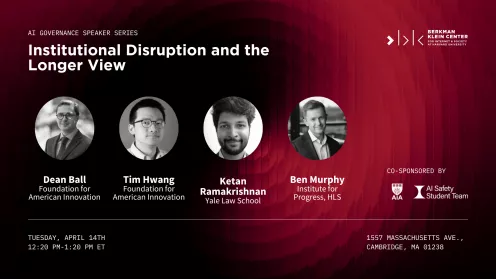


Most AI policy conversations start from the assumption that we're in unprecedented territory. But are we? This conversation brings together three scholars, all of whom regularly engage in today's policy battles, and zooms out to consider whether history has lessons for how our institutions should adapt to rapid technological change. Just how radically might AI destabilize and restructure our constitutional and political order? What historical analogues might guide us in thinking about how this process might, or should, unfold?
Part of the AI Governance Speaker Series co-sponsored by AISST and the HLS AI Law Association (AIA).
Speakers
Dean Woodley Ball is a senior fellow at FAI. He most recently served as senior policy advisor for Artificial Intelligence and Emerging Technology at the White House Office of Science and Technology Policy and strategic advisor for AI at the National Science Foundation. Previously he was a research fellow in the Artificial Intelligence & Progress Project at George Mason University's Mercatus Center and a policy fellow at Fathom.
Dean is author of Hyperdimensional. His work focuses on emerging technologies and the future of governance, spanning artificial intelligence, manufacturing innovation, neural technology, bioengineering, technology policy, political theory, public finance, urban infrastructure, and criminal justice reform. Outside of FAI, his scholarship has been published by the Mercatus Center, the Hoover Institution, the Carnegie Endowment for International Peace, the Federation of American Scientists, the Manhattan Institute, and American Compass.
Tim Hwang is general counsel and a senior fellow at the Foundation for American Innovation focused on emerging technologies and national security. He is also a senior technology fellow at the Institute for Progress, where he runs Macroscience. Previously, Hwang served as the general counsel and VP of operations at Substack, as well as the global public policy lead for Google on artificial intelligence and machine learning. He is the author of Subprime Attention Crisis, a book about the structural vulnerabilities in the market for programmatic advertising.
Ketan Ramakrishnan is an associate professor of law at Yale Law School. His interests include torts, AI regulation, constitutional law, contracts, property, and moral and legal philosophy. His articles on these subjects are published or forthcoming in the Harvard Law Review, University of Chicago Law Review, Yale Journal on Regulation, Fordham Law Review, and Philosophy & Public Affairs. He has also written on AI governance for the Carnegie Foundation, RAND, and Lawfare. Ramakrishnan is the associate reporter for the American Law Institute's Principles of Civil Liability for Artificial Intelligence project.
Ben Murphy (Moderator) HLS'27 is a Non-Resident Fellow at the Institute for Progress and a J.D. Candidate at Harvard Law School. His work focuses on how evolving technology interacts with existing public-law doctrines, with particular interest in historical analogues for technology-driven change in common law and the implications of AI for education. Previously, Ben worked as an early engineer at Substack and Inflection AI, and he was a Summer Fellow at the Centre for the Governance of AI. He holds bachelor's and master's degrees in computer science from Brown University.
You might also like
- communityJournalism in the Age of AI