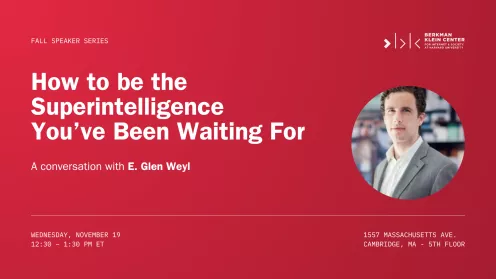


We alternately dread, worship and dismiss the arrival of Artificial Superintelligence (ASI). Yet the real superintelligences already surround us: religions, corporations, markets and democracies. This talk welcomes us to imagine not how we can build ASI that defeats us in all things, but instead how we can, together with our environment and machines, become a collectively self-aware global superintelligence.
Using economic theory as a translational formalism, Weyl illustrates how we can build core sociological ideas like community into algorithmic design and transform focal technical structures like neural networks into the design of social institutions. By transcending the misleading divide between social and technical systems, such joint engineering suggests a path away from both fear of ASI domination and its disappointing real-world performance.
This event was moderated by BKC Faculty Associate Professor Moira Weigel.
Speakers
E. Glen Weyl
E. Glen Weyl is Founder and Research Lead at Microsoft Research’s Plural Technology Collaboratory, Co-Founder and Chair of the Plurality Institute, Co-Founder of RadicalxChange Foundation and Co-Founder of the Faith, Family and Technology Network. Weyl collaborates closely with leading technology figures like Audrey Tang, Jaron Lanier, and Vitalik Buterin. He co-authored the influential book Radical Markets, the widely-read paper "Decentralized Society” and the first democratically self-governed and fully open source book ⿻ 數位 Plurality: The Future of Collaborative Technology and Democracy. Recognized as a leading thinker by WIRED and Bloomberg, Weyl graduated as Valedictorian from Princeton in 2007 and earned his PhD in economics from Princeton in 2008.
Moira Weigel
Moira Weigel is a BKC Faculty Associate and an Assistant Professor of Comparative Literature at Harvard University. She writes and teaches about the history, theory, and social life of media and communication technologies, from the early nineteenth century to the present. She originally trained in comparative literature and film studies, working in German, French, Spanish, and Mandarin Chinese. More recently, she has focused on data-driven technologies, particularly social media and marketplace platforms, as well as on new developments in artificial intelligence and machine translation.
You might also like
- news3 Questions Series
- communityDo you have a guilty AI secret?