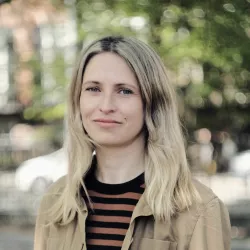
Dasha Pruss is an Assistant Professor of Philosophy and Computer Science at George Mason University.
Her research centers on the societal implications of carceral AI — algorithmic, data-driven systems designed to police, incarcerate, and control human beings. She draws on mixed methods to critically examine how normative values embedded in carceral AI systems are quietly reshaping the crime and punishment landscape, both in theory and in practice.
Dr. Pruss has written about recidivism risk assessment instruments, predictive policing tools, electronic monitoring, and other carceral technologies. Her work this year has two interwoven threads. The first is a participatory approach to evaluating, documenting, and contesting carceral AI systems, from a perspective that centers the experiential knowledge and interests of communities directly impacted by the technologies in question. In this vein, Dr. Pruss is a member of the Prison Data Collective, a coalition of interdisciplinary academic researchers and justice-impacted community members studying the realities faced by incarcerated people in Pennsylvania. Their work centers on the impacts of the Pennsylvania Department of Corrections intake process and transfer between prisons, with particular attention to STRONG-R, a proprietary risk assessment algorithm used to classify individuals into prison security level. The second thread investigates how human-AI interaction is mediated by organizational pressures in the criminal legal system, such as resource limitations and the politics of judicial elections, which complicates simplistic automation anxieties that dominate the literature on AI judges, AI police officers, and so on.
In prior work, Dr. Pruss examined how judges' discretion interacted with the introduction of a recidivism risk assessment instrument in the courtroom, and she aims to conduct a similar qualitative study on the interaction of correctional officers' discretion with inmate classification algorithms. Previously, Dasha was an Assistant Professor of Philosophy at the University of Illinois Chicago and a postdoctoral fellow at Harvard University, where she was jointly a fellow at the Berkman Klein Center and a postdoctoral fellow in the Embedded EthiCS program. She received her PhD in History & Philosophy of Science from the University of Pittsburgh in 2023, where she was a National Science Foundation graduate fellow, and holds a BS in computer science.

