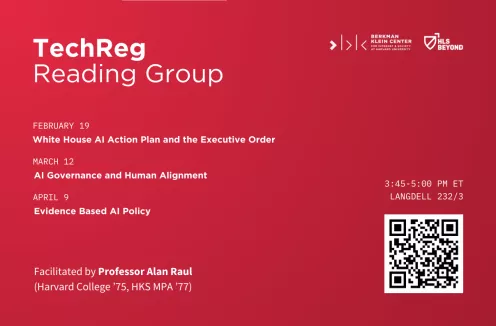
Presented with HLS Beyond, TechReg Reading Group in spring 2026 was led by Professor Alan Raul. Professor Raul led 3 sessions on AI under the Trump Administration.
The first session examined the current U.S. federal AI governance landscape under the Administration’s July 2025 AI Action Plan and December 2025 Executive Order 14365 (“Ensuring a National Policy Framework for Artificial Intelligence”).
Session 1: Where Do Things Stand w/ the AI Action Plan?
The first Spring 2026 TechReg session was held on Thursday, February 19, kicking off the second annual series of working group discussions about the latest developments in technology regulation. This session, the group zoomed out and took a bird’s eye view snapshot of the current AI governance climate in the Trump Administration in an event titled “White House AI Action Plan: Where Do Things Stand?”
Professor Raul started by providing the group a brief overview of the key parts of the Trump Administration’s AI Action Plan, including its three-pillar focus on Innovation, Infrastructure, and International Leadership. The group reflected on the repeal of the Biden Administration AI Executive Order(s) (EO) and questioned how much of the new direction of the Trump Administration was political signaling as opposed to a fundamental shift in policy. Consensus fell somewhere in the middle, as Professor Raul offered takeaways from the White House Office of Science and Technology Policy’s (OSTP) 1-year highlights report.
Dialogue next turned to actions that federal agencies have taken under the AI Action Plan. As the former General Counsel of the Office of Management and Budget (OMB), Professor Raul emphasized the unique role of OMB Guidance Memorandums in corralling agency leadership behind the scenes. As a result, many agencies have been tasked with following safety guidelines for AI deployment that are not as outwardly advertised as the Trump Administration’s accelerationist rhetoric. TechReg Student Research Assistant Jacob Levine then highlighted the Genesis Mission, a project made up of 26 key challenges and led by the Department of Energy in collaboration with private partnerships and National AI Laboratories.
Professor Raul concluded the session by engaging in a dialogue about the Trump AI moratorium EO and the downstream effects of potential federal funding cuts, the DOJ AI moratorium litigation task force, and legislative chill at the state level. The fight over AI governance between the Trump administration and the states was discussed as an area particularly ripe for the group’s attention moving forward.
Session 2 | March 12, 2026: AI Governance and Human Alignment
On Thursday, March 12, students from across Harvard formed a circle in Langdell Hall for a lively discussion about a timely real-world case study led by Professor Alan Raul. “AI at War: The Anthropic-Pentagon Clash” was the second of three TechReg working group sessions jointly hosted by the Berkman Klein Center (BKC) and HLS Beyond. Just days before TechReg Session 2, Anthropic sued the U.S. government in two Federal courts, challenging the company’s designation as a “supply chain risk” in the wake of a weeks-long feud with Secretary of Defense (“War”) Pete Hegseth and the Pentagon. This event recapped the latest developments, pondered likely next steps, and grappled with broader implications about future control of AI governance.
The conversation kicked off with a brief recap of the Anthropic-Pentagon clash: The primary dispute began when Anthropic’s CEO, Dario Amodei, refused Secretary Hegseth’s demand for the company to remove language in its government defense contracts prohibiting the use of its flagship generative AI model, Claude, in two use cases: (1) fully autonomous weapons systems and (2) domestic mass surveillance systems. Secretary Hegseth and the U.S. Department of Defense/War (DoD) sought language instead allowing the use of Claude for “all lawful purposes,” which resulted in an impasse between Amodei and Secretary Hegseth. Until then, Claude had been integrated into DoD and other Federal government workstreams, but following the dispute the Pentagon officially declared Anthropic a “supply chain risk” and threatened to invoke the Defense Production Act (DPA) to force Anthropic to remove its safeguards. Anthropic stood firmly by these two redlines restricting the use of Claude by the Federal government to a degree that Secretary Hegseth found intolerable.
After setting the scene, Professor Raul disclosed his own participation in the submission of an Amicus Brief in Anthropic’s lawsuit brought in the Northern District of California. Students debated the idea that socio-political conceptions of “wokeness” or “DEI” were at the root of the battle over control of Anthropic’s AI tools. Some noted that personality clashes between Amodei and Secretary Hegseth may have contributed to the tension as well.
Zooming out, Professor Raul asked students to weigh in on key questions: should a private company contracting with the government have the right to instruct the government about how their technology can be used? Can restrictions be placed on government use only when tailored to safety limitations or are value-based judgements fair game? Does this calculus change when AI—a transformative technology produced in the private sector but increasingly vital to national defense—is concerned? Analogies were made to fighter jets, missile systems, and other technologies produced by defense contractors. Students explored whether certain historical corollaries, if any, were helpful in understanding these big picture questions.
Turning to the legal issues, Professor Raul explained some incongruities between Anthropic’s two redlines and the DoD’s “all lawful uses” requirement. At the moment, many understand current U.S. policy to require a human-in-the-loop rather than any AI-enabled fully autonomous weapons system. Additionally, “domestic mass surveillance” is not necessarily a defined term of art and can encapsulate many completely legal and largely uncontroversial uses of AI technology, as well as a whole range of more egregious practices that may escape legal prohibition if not for Anthropic’s contractually-imposed limitations. This began a dialogue that considered whether Anthropic’s stance was rooted in avoiding liability and its own economic bottom line, or a deeper value determination. The attendees examined Amodei’s assertion that he had no principled objection to at least the “fully autonomous weapon system” use, clarifying that the company merely did not believe their technology to be ready for it yet.
The session wrapped up with an overview of Anthropic’s two legal challenges to the “supply chain risk” designation and Secretary Hegseth’s threat of DPA use against the company, two novel uses of existing government authority that have uncertain legal bases. Students falling along a range of perspectives about the recent events seemed to share a deep interest in the situation, seeing it as a case study in larger debates in both AI governance and executive power.
Session 3 | April 9, 2026: Evidence-Based AI Policy
