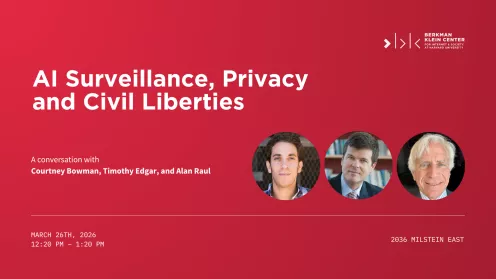


Artificial intelligence has made it possible for governments to aggregate, analyze, and act on data about individuals at a scale and speed that existing legal frameworks were never designed to address. The question of how to constrain that power, and who should control it, has become one of the defining governance challenges of our moment.
This conversation brings together Courtney Bowman, (Global Director of Privacy and Civil Liberties Engineering at Palantir Technologies) and Timothy Edgar (Lecturer at Harvard Law School), moderated by Alan Raul (Lecturer at Harvard Law School, Board Chair and President of the Future of Privacy Forum, and Board Secretary of the Society for the Rule of Law) to explore this vital issue from different perspectives.
Lunch will be served on a first-come, first-served basis.
This is an in-person only event, and there will be no recording. This event is open to Harvard ID holders only.
Speakers
Courtney Bowman is Global Director of Privacy and Civil Liberties Engineering at Palantir Technologies. His work addresses the confluence of issues at the intersection of policy, law, technology, ethics, and social norms. In working extensively with government and commercial partners, Bowman’s team focuses on enabling Palantir to build and deploy data integration, sharing, and analysis software that respects and reinforces privacy, security, and data protection principles and community expectations. In his role, Bowman also works with the privacy advocacy world at large to ensure that concerns related to new and emerging technologies and data sources are addressed in the ongoing design and implementation of Palantir’s software platforms. Bowman is a frequent commentator on issues surrounding AI ethics, efficacy, and operationalization. Prior to Palantir, Bowman earned degrees in Physics and Philosophy at Stanford University and worked as a quantitative and economic analyst at Google.
Timothy Edgar is a lecturer at Harvard Law School and a leading expert on cybersecurity and privacy with over two decades of experience as a privacy and civil liberties lawyer. Edgar is a professor of the practice of computer science at Brown University, a senior fellow at the Watson School of International and Public Affairs, and helped launch Brown’s cybersecurity master’s degree program. He also teaches a course in the legal problems of cybersecurity at Harvard Law School, where he is a lecturer on law. Edgar is a contributing editor to Lawfare and has written for the Wall Street Journal, the Los Angeles Times, the Guardian, Foreign Affairs, and Wired. He is regularly quoted in the national press and has often testified before Congress.
Alan Raul is a Lecturer at Harvard Law School, Board Chair and President of the Future of Privacy Forum, and Board Secretary of the Society for the Rule of Law. He founded and led Sidley Austin LLP’s global Privacy and Cybersecurity practice for over twenty-five years. Raul now practices law and undertakes strategic and advisory projects as Principal of Raul Consulting Company, advising companies and boards on regulatory enforcement, crisis management, compliance and due diligence regarding data practices, information technology, artificial intelligence, and cyber attacks, breaches and software vulnerabilities. At Harvard Law School, Raul teaches “Digital Governance: Privacy, Artificial Intelligence and Information Technology.” He is also an Affiliate of Harvard’s Berkman Klein Center for Internet and Society.
You might also like
- communityJournalism in the Age of AI
