

Update:
The start time of this event has been changed to 5:00 pm.
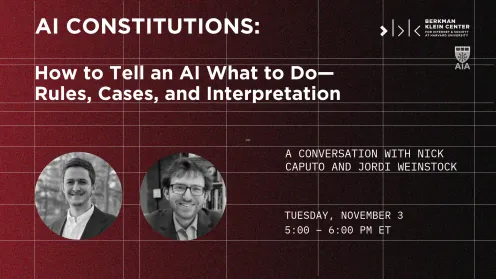
What can the law teach us about where AI systems should exercise judgment when their instructions leave room for interpretation?
AI developers now govern their most capable models through written “constitutions.” These documents set out a model’s values, priorities and character, and they’re used directly in training. Anthropic’s constitution for Claude is the most prominent example. These documents raise questions that law has dealt with for centuries. Who has the authority to write them? How should vague principles be interpreted when they conflict? Can a model meaningfully consent to the values it’s trained on? What role, if any, should governments play?
Nicholas Caputo (Johns Hopkins School of Government and Policy; Oxford Martin AI Governance Initiative) and Jordi Weinstock (Harvard Law School; Berkman Klein Center) will discuss what legal theory can and can’t tell us about AI constitutions. Caputo’s research treats AI alignment as a problem of jurisprudence, and his work in progress asks whether Claude can consent to its own constitution. Weinstock teaches at Harvard Law School about the confluence of AI and traditional law and served as an external reviewer of Claude’s constitution.
You might also like
- communityBetter Tech
