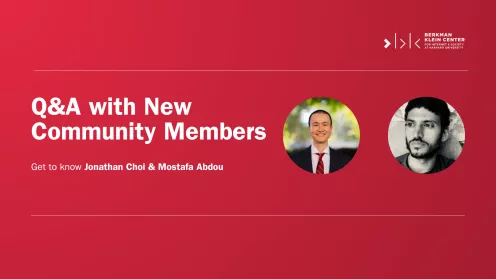
Community Q&A: Jonathan Choi and Mostafa Abdou
The Berkman Klein Center welcomes Jonathan Choi and Mostafa Abdou as new members of the BKC community. Jonathan is a Faculty Associate with expertise in law and AI. Mostafa is an Affiliate with a background in medicine, and is currently exploring as well as language and psychiatry.
BKC conducted a quick Q&A with Jonathan and Mostafa to learn more about their research. The responses below have been lightly edited for grammar and clarity.
Which community or communities do you hope to most impact with your work?
Jonathan Choi (JC): I hope that my work will help policymakers—judges, regulators, legislators—to understand the promise of AI and apply it responsibly.
Mostafa Abdou (MA): I hope my work can contribute to the efforts of those who, like me, are trying to critically engage with a reality in which technology increasingly appears less as a product of collective choice and more as an autonomous force shaping our lives—something that “happens to us”.
What’s something about your work that you think would surprise people?
JC: Although I'm excited right now about practical applications of LLMs in government, I normally don't write about law and technology—I mostly study traditional legal topics (tax law, statutory interpretation, judicial behavior, policing) using NLP methods.
Why is your work important right now?
JC: LLMs have opened up new possibilities for cheaper dispute resolution and more efficient government, but the risks are high, and misunderstandings about the capabilities of LLMs are very common.
MA: A large part of why I see it as important is that digital technologies, both the tools themselves and the systems around them, have become one of the main ways in which power is produced and exercised today.
Jonathan, what can LLMs do in legal empirical studies that humans cannot?
JC: LLMs can analyze massive text datasets that humans couldn't feasibly tackle, like reading through millions of cases or identifying trends in millions of regulations. We can also produce new types of quantitative analysis with LLMs, like fine-tuning them to predict case outcomes and then using the fine-tuned LLM to understand which case attributes matter most to judges.
What role do you see LLMs playing in your field 2 years from now?
JC: No need to wait 2 years! It's already a cliche that scholars hiring human RAs to code variables will be asked why they didn't use an LLM instead.
Mostafa, what do you think is missing in conversations about how AI tools impact well-being?
MA: Among many other things, two things especially stand out to me: first, a clearer sense that developments in AI—and in technology more broadly—are not inevitable, and that it’s anything but normal for the public to have so little say in how they unfold; and second, a deeper look at how these tools are slowly altering our minds, our attention, and the way we feel.
What’s one of the most significant ways you believe AI has transformed society thus far?
MA: The large-scale economic restructuring happening as a consequence of the AI arms race—huge investments in computing infrastructure and chip manufacturing, major re-allocation of resources like water and electricity, rapid expansion in defense sector funding to develop autonomous weaponry and other military applications—is already having very visible effects on global trade norms, labor markets, and our living environments.
You might also like
- storyAI as commons