Politics and Technology of Control: Introduction: Difference between revisions
| Line 65: | Line 65: | ||
== Class Discussion == | == Class Discussion == | ||
<div style="background-color:#CCCCCC;">Welcome to Internet and Society: Technologies and Politics of Control! This is the section of the page where you should add your comments to complete "assignment zero." Once you have registered an account, just click the "[edit]" button at the upper right hand corner of this section to add text! You can add a divider between comments by typing four hyphens (<nowiki>----</ | <div style="background-color:#CCCCCC;">Welcome to Internet and Society: Technologies and Politics of Control! This is the section of the page where you should add your comments to complete "assignment zero." Once you have registered an account, just click the "[edit]" button at the upper right hand corner of this section to add text! You can add a divider between comments by typing four hyphens (<nowiki>----</nowiki>) between comments. '''Please remember to sign your postings by adding four tildes (<nowiki>~~~~</nowiki>) to the end of your contribution. This will automatically add your username and the date/time of your post, like so: [[User:Andy|Andy]] ([[User talk:Andy|talk]]) 09:50, 21 January 2015 (EST)</div> | ||
Revision as of 14:50, 21 January 2015
January 28
The Internet at its core is simply an expression of a technological protocol that allows for a particular way of sharing information. But its role has never been this understated. The Net has great potential for “good” (e.g. innovation, economic growth, education, and access to information), and likewise is a great platform for the bawdy, tawdry and illegal. So is this platform about fundamental social, political and economic change, or about access to solipsistic blogging, pornography, cheap pharmaceuticals, free music, and poker at home? This question leads us to a host of interesting issues that weave their way through the course related to openness, access, regulatory control, free speech, anonymity, intellectual property rights, democracy, transparency, norms and values, economic and cultural change, and cyber-terrorism, as well as scamsters and thieves.
Download slides from this week's class.
There is a small assignment to do before class. See Assignment Zero below.
Preparation (Assignment "Zero")
Reflect on what you believe are the most significant social, cultural, political or economic changes associated with the spread of digital technologies. In a few sentences, please offer 2-3 examples in the Class Discussion section below and be prepared to discuss them during class.
Readings/Watchings
What is the Internet?
- Ethan Zuckerman, History of the Internet (approx. 7 mins., watch all)
- Jonathan Zittrain, How the Internet Works (approx. 4 mins., watch all)
How does the Internet change governance?
- Rebecca MacKinnon, Let’s Take Back the Internet! (TED.com) (approx. 15 mins., watch all)
Who governs the Internet?
- ICANN, Who Runs the Internet? (infographic)
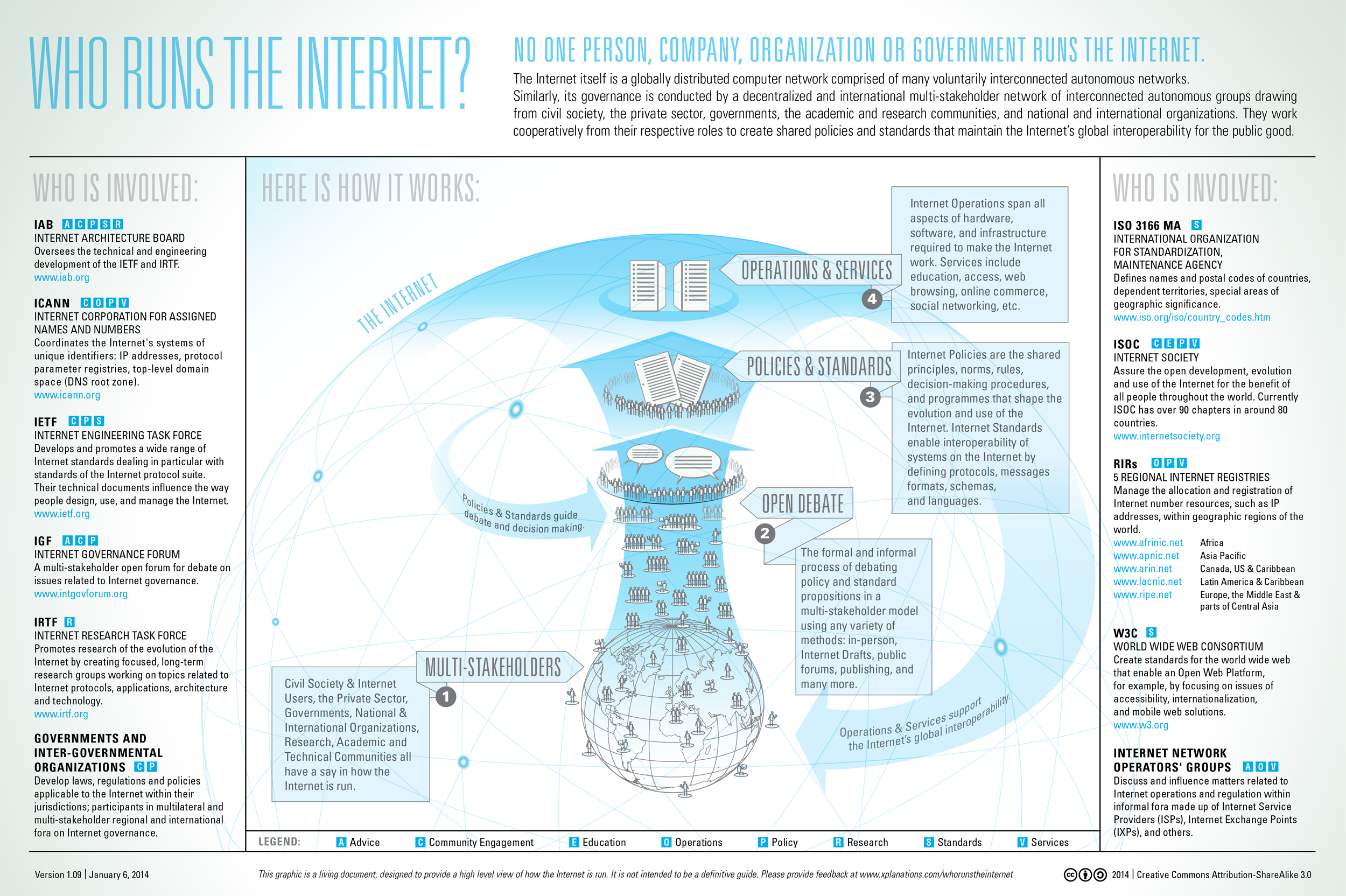
- Alex Simonelis, A Concise Guide to the Major Internet Bodies (skim, but focus on ICANN, IETF, IANA, and W3C)
Who is the Internet? Who is it not? What can we do about it?
- Eszter Hargittai, The Digital Divide and What to Do About It (New Economy Handbook) (focus on Sections I-III)
- Hargittai’s data is from 2003. For more recent data, see Pew Internet & American Life Project, Who's Not Online and Why (read the summary, skim the sections).
- Ethan Zuckerman, Why Our Webs Are Rarely Worldwide, And What We Can Do About It (approx. 14 mins., watch all)
Optional Readings
- Ellery Biddle, Who Controls the Internet? (Global Voices) (video in Spanish with English subtitles, 10 mins., watch all)
- Chris Locke, Doc Searls & David Weinberger, Cluetrain Manifesto (just the manifesto)