Politics and Technology of Control: Introduction: Difference between revisions
BerkmanSysop (talk | contribs) m 1 revision: Content from IS2013 wiki. |
No edit summary |
||
| (195 intermediate revisions by 68 users not shown) | |||
| Line 1: | Line 1: | ||
{{ClassCalendar}} | {{ClassCalendar}} | ||
'''January | '''January 27''' | ||
'''''Class was cancelled on this day due to snow. Please see the class video for day 2 for the discussion of this material.''''' | |||
The Internet at its core is simply an expression of a technological protocol that allows for a particular way of sharing information. But its role has never been this understated. The Internet has great potential for “good” (e.g. innovation, economic growth, education, and access to information), and likewise is a great platform for the bawdy, tawdry and illegal. So is this platform about fundamental social, political and economic change, or about access to solipsistic blogging, pornography, cheap pharmaceuticals, free music, and poker at home? This question leads us to a host of interesting issues that weave their way through the course related to openness, access, regulatory control, free speech, anonymity, intellectual property rights, democracy, transparency, norms and values, economic and cultural change, and cyber- terrorism, as well as scamsters and thieves. | |||
'''There is a small assignment to do before class. See [[#Preparation (Assignment "Zero")|Assignment Zero]] below. | |||
== Preparation ("Assignment Zero") == | |||
Reflect on what you believe are the most significant social, cultural, political or economic changes associated with the spread of the Internet and digital technologies. In a few sentences, please offer 2-3 examples in the [[#Class Discussion|Class Discussion]] section below and be prepared to discuss them during class. | |||
<onlyinclude> | <onlyinclude> | ||
| Line 13: | Line 17: | ||
== Readings/Watchings == | == Readings/Watchings == | ||
* [https://www.youtube.com/watch?v=V2QdEj8UjBc Ethan Zuckerman, History of the Internet] (approx. | '''What is the Internet?''' | ||
* [https://www.youtube.com/watch?v=V2QdEj8UjBc Ethan Zuckerman, History of the Internet] (approx. 7 mins., watch all) | |||
* [https://www.youtube.com/watch?v=whmMNRHktX8 Jonathan Zittrain, How the Internet Works] (approx. 4 mins., watch all) | * [https://www.youtube.com/watch?v=whmMNRHktX8 Jonathan Zittrain, How the Internet Works] (approx. 4 mins., watch all) | ||
'''How does the Internet change governance?''' | |||
* [https://projects.eff.org/~barlow/Declaration-Final.html John Perry Barlow, A Declaration of the Independence of Cyberspace] | |||
* [http:// | :* You can hear Barlow read this [http://departmentofrecords.co/dor1.html here]. | ||
* [http://www.legalaffairs.org/issues/January-February-2006/feature_goldsmith_janfeb06.msp Jack Goldsmith & Tim Wu, Digital Borders (Legal Affairs)] | |||
* [http://www. | |||
* [http://blog.ericgoldman.org/archives/2009/03/the_third_wave.htm Eric Goldman, The Third Wave of Internet Exceptionalism] | * [http://blog.ericgoldman.org/archives/2009/03/the_third_wave.htm Eric Goldman, The Third Wave of Internet Exceptionalism] | ||
* [https:// | * [https://medium.com/@internetmonitor/platforms-and-policy-e9984e1be4c6 Rob Faris and Rebekah Heacock, Platforms and Policy] (from the [http://thenetmonitor.org/research/2014/ 'Internet Monitor' 2014 annual report]) | ||
* [http://www.ted.com/talks/rebecca_mackinnon_let_s_take_back_the_internet.html Rebecca MacKinnon, Let’s Take Back the Internet! (TED.com)] (approx. 15 mins., watch all) | |||
'''Who governs the Internet?''' | |||
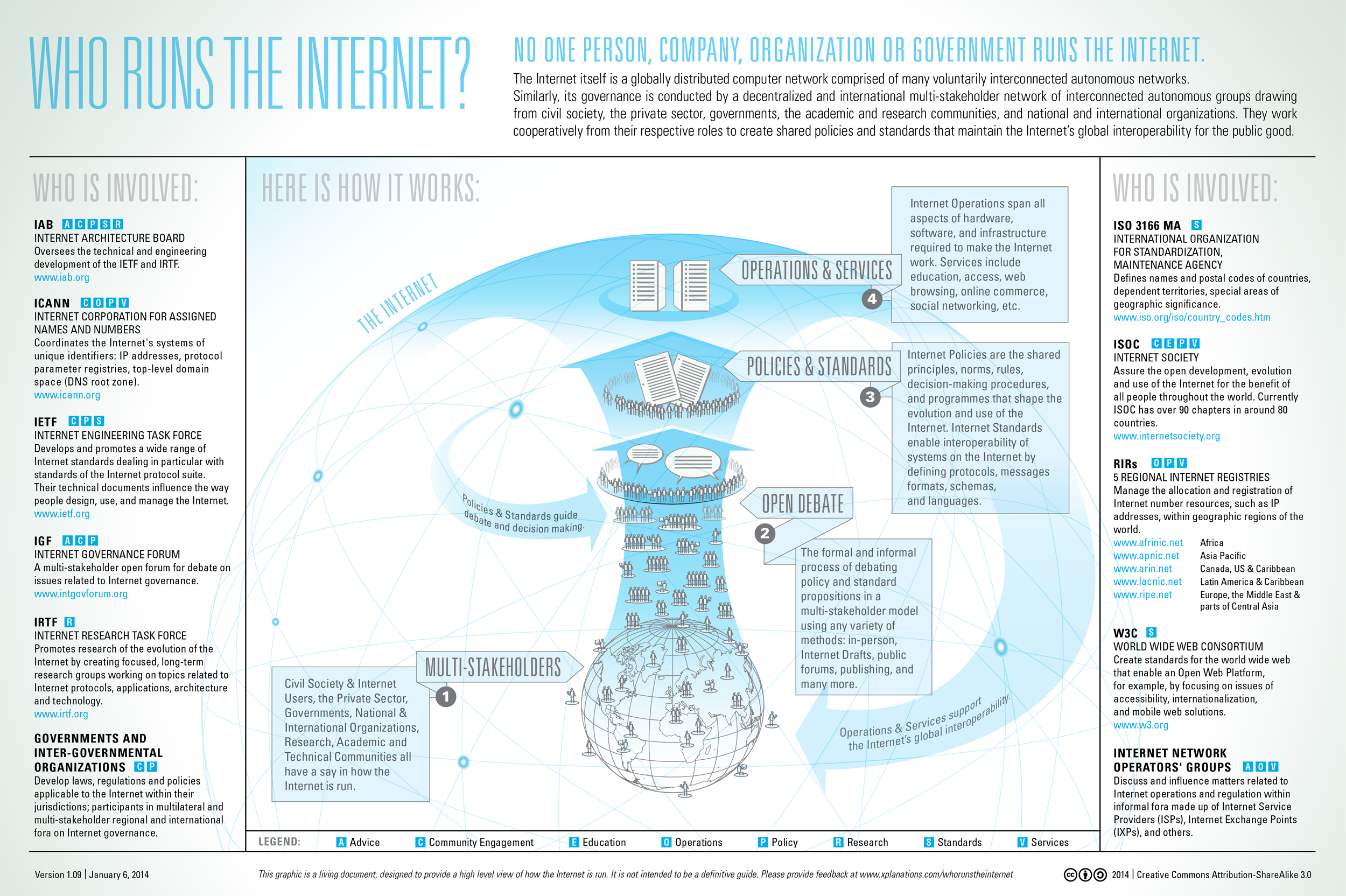
[http://www. | * [http://www.icann.org/sites/default/files/assets/governance-2500x1664-13jan14-en.png ICANN, Who Runs the Internet?] (infographic) | ||
[http:// | * [http://ubiquity.acm.org/article.cfm?id=1071915 Alex Simonelis, A Concise Guide to the Major Internet Bodies] (skim, but focus on ICANN, IETF, IANA, and W3C) | ||
'''Who is the Internet? Who is it not? What can we do about it?''' | |||
* [http://www.webuse.org/pdf/Hargittai-DigitalDivideWhatToDo2007.pdf Eszter Hargittai, The Digital Divide and What to Do About It (New Economy Handbook)] (focus on Sections I-III) | |||
:* Hargittai’s data is from 2003. For more recent data, see [http://pewinternet.org/~/media//Files/Reports/2013/PIP_Offline%20adults_092513_PDF.pdf Pew Internet & American Life Project, Who's Not Online and Why] (read the summary, skim the sections). | |||
* [http://www.youtube.com/watch?v=mNHkG7w2IA8 Ethan Zuckerman, Why Our Webs Are Rarely Worldwide, And What We Can Do About It] (approx. 14 mins., watch all) | |||
== Optional Readings == | |||
* [http://advocacy.globalvoicesonline.org/2013/12/04/video-who-controls-the-internet/ Ellery Biddle, Who Controls the Internet? (''Global Voices'')] (video in Spanish with English subtitles, 10 mins., watch all) | |||
* [http://www.cluetrain.com Chris Locke, Doc Searls & David Weinberger, Cluetrain Manifesto] (just the manifesto); and [http://cluetrain.com/newclues/ New Clues] | |||
* [https://papers.ssrn.com/sol3/papers.cfm?abstract_id=1752415 Tim Wu, Is Internet Exceptionalism Dead?] | |||
* [http://www.ethanzuckerman.com/blog/2012/12/05/good-and-bad-reasons-to-be-worried-about-wcit/ Ethan Zuckerman, Good and Bad Reasons to be Worried About WCIT] | |||
</onlyinclude> | |||
== Videos Watched in Class == | |||
== Links From Adobe Connect Session == | |||
== Class Discussion == | |||
<div style="background-color:#CCCCCC;">Welcome to Internet and Society: Technologies and Politics of Control! This is the section of the page where you should add your comments to complete "assignment zero." Once you have registered an account, just click the "[edit]" button at the upper right hand corner of this section to add text! You can add a divider between comments by typing four hyphens (<nowiki>----</nowiki>) in an empty line between comments. '''Please remember to sign your postings by adding four tildes (<nowiki>~~~~</nowiki>) to the end of your contribution. This will automatically add your username and the date/time of your post, like so: [[User:Andy|Andy]] ([[User talk:Andy|talk]]) 09:50, 21 January 2015 (EST)</div> | |||
---- | |||
One of the more significant social and economic changes that I have not only experienced but seen, is the ability to find things out instantly. Whether it be news or education, sports or politics, we now have the ability to informed immediately about anything and everything. This is both a blessing and a curse.[[User:ErikaLRich|ErikaLRich]] ([[User talk:ErikaLRich|talk]]) 17:06, 3 February 2015 (EST) | |||
---- | |||
The most significant social change resulting from the spread of the Internet is simply the opportunity for the average person (whoever that may be) to establish two way connections with people, businesses, information, and governments around the world in other than a physical environment. Having two way communication, even if indirectly, is empowerment. I grew up in a world of listeners and watchers, from newspapers, to magazines, radio, broadcast television, and brochures. The Internet has given us a world filled with conversation. | |||
The most significant economic change is online sales of goods and services. I can buy just about anything on the Internet and never leave my home, my office, or the beach. I can’t imagine where I would have to physically go to buy, or how I would even locate, a 2 kilogram box of Scharfenberger cocoa without the Internet. I just would not take the time to locate it, and for that reason I would not buy it. More to the point, it would not be sold. | |||
Culturally, email is the big change. Of course, instant messaging and social media are gaining ground, but it was email that changed our culture to the right now work and personal environments, even before it was being delivered on the cell phone. Wait, maybe the cell phone is a bigger change. [[User:Gary Brown|Gary Brown]] ([[User talk:Gary Brown|talk]]) 15:51, 3 February 2015 (EST) | |||
---- | |||
There | There is some fascinating discussion taking place “below the line.” It makes me excited for this semester. To my mind, the internet and associated digital technologies remain the most influential invention of our time. They have been the facilitator of countless zeitgeists including the crumbling of oppressive kingdoms and the exploration of alternative currencies, as well as the breeding ground for unique forms of intellectual and social collaboration- be they twitter, Jstor journals, or your average online message board. This interconnectivity is, of course, not without its side-effects. While the relationship between various exchange and interest rates pre-dates the proliferation of the internet, I feel that such technologies have allowed the more unsavory characteristics of these economic relationships to be felt much more acutely by the average person.[[User:Jmerryma0287|Jmerryma0287]] ([[User talk:Jmerryma0287|talk]]) 14:39, 3 February 2015 (EST) | ||
---- | |||
One of the more recent ways in which the Internet is shaping our sociopolitical discourse is through the creation of strong cyber networks for more marginalized communities. For example, the rise of feminist blogs and message boards or hashtags such as #blacklivesmatter can be used in connecting online activity and writing to other forms of non-cyber activism and understanding. | |||
In terms of economic changes prompted by the Internet, online capitalist competition has facilitated the growth of huge online sellers of a variety of goods with versatile virtual purveyors like Amazon. ([[User:Amchugh|Amchugh]] ([[User talk:Amchugh|talk]]) 13:33, 3 February 2015 (EST)) | |||
---- | |||
Digital technologies have changes many aspects of life and society. One example is the fact that I can participate in this class even though I live in Europe. That is just one example of how digital technologies have played a huge part in globalization. Even though I live in Sweden, I can still study at an American university, easily stay in touch with my best friend who lives in Missouri, I can follow the life of a stranger in Australia through his or her blog, and I can connect and share my thoughts with other people who think like me but who live in other parts of the world. As a young person of today, I do not only identify myself as a citizen of a particular city, but also as European or as a ”global citizen”. | |||
I | What is also important to reflect on is how we can influence and affect others through the Internet and digital media. (And of course how we are influenced and affected by others.) One out of many possible examples on this matter is blogs. I use the Swedish blog ''blondinbella.se'' as my example. ”Blondinbella” is one of the most popular blogs in Sweden with over 1 million unique readers each week. Sweden a country with only about 10 million citizens, and that one blog reach more people than many newspapers do is very interesting and worth reflecting about. [[User:JosefinS|JosefinS]] ([[User talk:JosefinS|talk]]) 03:40, 26 January 2015 (EST) | ||
---- | |||
I completely agree with what Josefin said above. The generation that is now entering adulthood is inheriting a much smaller, more connected world than their parents did. | |||
I think it's important to reflect on the possible downsides of the ever increasing invasiveness of the internet. We are a generation that can ask Siri how badly the Patriots beat the Seahawks in the Superbowl — and she’ll tell us almost immediately that the Patriots won in a landslide. Or what song is playing on the radio. Or what the largest star in the Milky Way is. Or if Pixar is ever going to make a sequel to the Incredibles (they are, finally). You get the point. We are used to being able to find out almost anything, almost anywhere, at almost anytime. | |||
There may be a subtle danger in adapting an entire generation to instant gratification. As we put more and more of our lives into our phones and computers, we stop relying on our own mental faculties. For example, my grandfather has a razor sharp memory, and he knows all the phone numbers of our immediate and extended family by heart. If I lost my phone, I might remember my mom’s number, but my whole contact book would be lost if it wasn't for iCloud. I’m certainly not exercising my memory on a daily basis to make calls like my grandfather. Will that hurt me in the long run? Probably not — but it’s an interesting thought. | |||
[[User: | Another aspect of the internet that I sometimes reflect on is its contribution to political close-mindedness here in the US, if not the world over. I worked for a long time in DC, and have friends and family all over the political spectrum — even a tea party uncle in Texas, and I can say with certainty that I’ve witnessed a trend where my highly conservative friends will follow and subscribe to conservative news sources or blogs that produce news that corresponds with their pre-existing beliefs, and like-wise for my liberal friends. Constant exposure to “news” written or spun to enforce and vindicate your beliefs serves to cement your views, and lessens the amount of meaningful debate that takes place. I would say this definitely serves to further polarize the political climate here in the US. Sean Hannity, Rush Limbaugh, Jon Stewart, Stephan Colbert, all have large followings of people who watch their shows, listen to their radio stations, and subscribe to their social media outlets. The political influence of these individuals can, in some cases, easily shape the political landscape more than many politicians do. Interesting to consider. [[User:WesleyVerge|WesleyVerge]] ([[User talk:WesleyVerge|talk]]) 23:46, 26 January 2015 (EST) | ||
---- | |||
Wesley Verge. The polarization of American Politics on the internet reflects popular attitudes, and at times exacerbate the problem. I think the problem has to do with journalistic standards. Remember those? They used to exist up until about the 1990's, or more precisely, since Rupert Murdoch bought Fox News -- and that's when the bar was lowered for everyone. With such a wide reach, high profits, and such obvious bias on all the publications under his ownership, journalistic standards went out the window in the pursuit of sensationalism and profit margin. And sadly, those who didn't adapt to this new way of selling news were left behind. The Philadelphia Inquirer comes to mind, but R. Murdoch's purchase of the Wall Street Journal is another good example. U.S. Politics have been in a sad state of affairs since G.W decided to invade Iraq, and the rancor and indignation that followed those years has still to subside. There are other factors that affect the current state of politics in the U.S, and two of those are geography and the diversity of demographics throughout the country. Notice that there isn't really a traditional democratic and republican party? Despite the fact that the two party system is still dominant in voting patterns, there are many factions within those two large groups. Hromero [[User:Hromero|Hromero]] ([[User talk:Hromero|talk]]) 12:41, 29 January 2015 (EST) | |||
---- | |||
Hromero. You make valid points, though I would point out that they differ slightly from the point I was trying to make. To elaborate a little further, I was speaking only of how the internet plays a large role in exacerbating the political polarization of the country. You correctly point out that the shift in media tactics marked a shift towards increased polarization. I'm saying that the internet provides access to sensationalist news and propaganda, on both sides of the spectrum, to anyone with a connection or a smart phone. People no longer have to be challenged in their thinking. If the President says "yadayadayada", rather than reflect upon and come to consensus, people are bombarded with sound bites that penetrate the public sphere and shape political thought. New ideas never have the chance to take root, because they are razed quite immediately after inception. Of course, talking head pundits are nothing new, but at least years ago families could discuss news together over dinner, waiting to read the paper or see the news the next day. Now, The President says "yadayadayada" at 6pm, and John Boehner is able to issue a responsive speech at 8pm through twitter or youtube. You're right to point out the increased splintering of the parties, but where that meets the internet is now each of those factions has methods to connect to their support bases, issue videos, etc on a constant and consistent basis -- a change that surely helps to solidify and expand their support, further polarizing the country. I think its important that we focus on how the internet is used in correlation to politics, rather than focus on the people doing the using and whether or not we agree with them. It keeps discussion more clear and concise. [[User:WesleyVerge|WesleyVerge]] ([[User talk:WesleyVerge|talk]]) 17:37, 30 January 2015 (EST) | |||
---- | |||
[[User: | The evolution of the internet and our digital technologies has changed how we look at society and how we participate in it. For example social outlets such as Facebook and Twitter allows us to express any thought or feeling and connect with people all over the world. This gives us the ability to form connections and relationships with people that would not have been possible otherwise. With the internet always evolving information has become more and more accessible. Anything that we can imagine we can find through the Internet whether that be current events, a movie review, or personal information just to name a few. Search engines and online encyclopedias such as Google and Wikipedia have changed how we learn and search for information. Furthermore the internet has changed the way we do business . Now we are able to purchase products through websites like Amazon and any other retail site. We also can conduct business through the internet through trading which adds a new dimension to the business world. Our advancements in the internet and digital technologies added another wrinkle in how we view information and the economy as well as many other areas. [[User:Jan.Yburan|Jan.Yburan]] ([[User talk:Jan.Yburan|talk]]) 15:07, 27 January 2015 (EST) | ||
---- | |||
As a distance student, participation has been possible in many HED classes with students world wide from Singapore, Malaysia, Great Britain, Indonesia, and Australia as well as the United States. The advantages the internet and exponential expansion of digital constantly creates awe in realizing what has become possible in a relatively short period of time. | |||
It is possible to access historical and current information from the Internet from each of the categories listed above almost instantaneously whether it be cultural, political or economic or social. The online Wikipedia information saves gong to the library or an encyclopedia with each query…..which in the case of the library has advantages as well as disadvantages. For lovers of books, there is nothing like thumbing through the pages of a book….and reading the first and last chapter while standing in front of a bookshelf. | |||
Shopping - it is possible to view the price and merchandise of a particular brand or manufacturer with a few keystrokes. A person can shop locally or nationwide or overseas for particular items. [[User:Rgrasser|Rgrasser]] | |||
---- | |||
I like many of the posts above, and I think they're on the mark. My first thought on changes ushered in has to do with Wesley's comments on instant gratification - we can access information and purchase goods instantaneously, but being connected means we are always on-call. A text/SMS comes to our phones on our bodies, we don't want to be behind on emails or miss a post on Facebook, etc. The new, immediate connectedness of the turn of the century, it seems to me, is significantly notable, both in our ability to connect and the possibility of always being connected to. | |||
This new connection brings me to my second thought, the new possibilities of surveillance. Typically conversation focuses on government censorship and the ability to monitor for unwanted speech. I would add that our new, ongoing connectedness also provides an increasingly continuous history of our identities. This history can be used to market specific products, tailor our searches, and generally show us content that will keep us connected more often. To be connected means to be watched, sometimes directly, sometimes passively. Many have written on how this leads us to begin policing ourselves. | |||
This self-policing brings me to third major development I see, which also has much to do with Wesley's thoughts on how his friends' political views are continually fed. A variety of technologies now exist to keep us more within our preconceptions than before. Our identity and self-understanding is produced and maintained in a different and more controlled way in the past. It doesn't seem to me that there is (necessarily) a (wo)man behind the curtain, but the implementation and effect of these technologies remain the same. | |||
[[User:MattK|MattK]] ([[User talk:MattK|talk]]) 17:42, 27 January 2015 (EST) | |||
---- | |||
Internet access has changed the way information flows while increasing social and economic participation. As internet and digital technology continues to develop, it has changed the nature of how organizations market themselves to targeted their targeted consumers. Traditional methods of newspaper/magazine advertisements and email listservs no longer are the primary avenue of increasing consumer engagement. Social media platforms have expanded consumer outreach as companies use Twitter to tweet to their customers and smartphone apps to keep their consumers connected. This connectectivity has impacted the roles of employees as many of their job descriptions are now requiring evidence of technological competencies. | |||
The internet and technologies has allowed the progression of global connectivity by creating meaningful experiences through intentional dialogue and engagement. Internet and digital technologies allows for access to consumer services previously limited due to geographic location. Historically, a fitness coach was someone typically found within your local community or an athlete was required to travel to the gym/sports facility. With the expansion of technology, people now have access to some of the best coaching in the world through the use of current technologies. As an example, I am now a posing coach for athletes throughout the USA, Canada and the UK. | |||
People are now able to engage in a global experience without crossing international borders. [[User:Tasha|Tasha]] ([[User talk:Tasha|talk]]) 18:57, 27 January 2015 (EST) | |||
---- | |||
While reflecting on the Internet and the significant changes it has spread, I ironically type and post the following comments while flying on an airplane. Who would have imagined using internet on a plane 20 years ago? Yet, walking through the airport before boarding my flight I could see the changes the Internet and digital technologies has had on our society: customers ordering food via an iPad in the airport cafe; an older couple Skyping, what looked like their grandson, on a laptop; teenagers idly staring at their smart phones while their parents talk at them; the many airline passenger who boarded their flights by merely pulling up an image on their iPhones. Internet and digital technologies are everywhere...and it has changed every aspect of our lives. | |||
The | The most significant of those changes I find is the globalized world we now live in. Post World War II, the international community entered an era of connectedness, and the Internet has only exacerbated this connectedness. The ability to share, like, post, tweet, retweet, reblog, blog, etc. has birthed a generation of globally connected citizens. It only takes a couple of clicks on Twitter to see or read about happenings half way around the world - in real time. This environment has created a more involved international community, especially when reviewing Twitter trending topics, for instance the events that happened in Ferguson, MO last year. Massive marches, stand ins, protests and rallies were organized across the globe - orchestrated primarily on social media. | ||
Furthermore, the possibilities of outreach and global awareness is boundless. Internet and digital technologies now offer a tool for social good. | |||
A recent article [http://www.information-age.com/technology/mobile-and-networking/123457289/facebook-launches-bid-to-bring-cheap-internet-to-the-developing-world] discussed how internet has become vital to survival for those living in the poorest of countries. Facebook, for example, launched a program with efforts to bring internet to lower income countries or rural areas who need the assistance with technology to better living conditions. The implementation of these technologies are ongoing, and it is unclear if they are helping more than they are hurting, but the social change of internet is here to stay. | |||
[[User:Mhoching|Mhoching]] ([[User talk:Mhoching|talk]]) 07:35, 28 January 2015 (EST) | |||
---- | |||
Ok, speaking of internet morons, this is the third time I’m posting and I still don’t see it. Any tech has any hints as to why this is happening, I’m making a copy of this in a separate doc, please tell me where to send it. | |||
My comment is as follows: 1) Since the advent of the internet people are interacting with devices and technology more often than they used to and as a result there have been some measurable changes in children’s cognitive development. I will find the resource later on. I think it also affects adults, especially those who are already predisposed to HDHD. 2) since it is very hard to tell when you’re blogging whether you’re speaking to only three people or three thousand, the power of bloggers should be taken with a generous dose of skepticism. 30 Innovation does not necessarily make us more effective, it merely makes us busier. Exhibit A: Facebook (A complete waste of time, and a truly distracting way of communicating with other people. Absolutely hate it.) Hromero[[User:Hromero|Hromero]] ([[User talk:Hromero|talk]]) 15:01, 28 January 2015 (EST) | |||
---- | |||
Reflecting how the world has changed in the last few years is impressive, many things that could not be dreamed to be done in any other way that would have been physical, now in our current times, are possible. | |||
Socially, the interaction of people on facebook and other social networks, like blogs, etc, have become from informational, to a way how people can meet one another, interact, and even date. This in the past was never thought, and now relationships, interaction of groups, like chats are very common. Social networks have | |||
Culturally, it is important to see that there is a subculture, mostly in teenagers and younger people, the subculture, of the I Pad, and tablet, and aps people who are identified, by their cell phones, ring tones, and other characteristics of technology. This differs from the older generation that would not do monetary transactions, meet people, or even gather around a computer, this older folks may prefer to go to the bank, gather with friends, and bring a guitar and play. The culture has been subdivided. | |||
Economically, Pay pawl, and other providers like e-bay, has become very popular in the market, aps for real estate and westlaw, for the legal field, has caused a huge impact, on people and their economy, it is taken over many jobs, and also has make people gain a lot o money, people needed to physically be instructed by someone or by reading, and now there is more accessibility through the internet, where most people can find the answers the they need most of the time. The economy is being monopolized by the electronic era. (Edwin Duque) | |||
---- | |||
I agree with my colleagues contributions above. There is no doubt that we've had significant social, cultural, political, and economic changes associated with the spread of the Internet and digital technologies throughout the years in both spheres personal and professional. | |||
Regarding the personal impacts, one example is that if we think about the new generation of people that is part of what they call "Generation Z", instead of playing with the traditional toys that we had in our childhood, when they are kids their main entertainment are the electronic devices with Internet access. A one-two year old child currently simply grab their parent's iPads/tablets or smartphones and play with apps. It's impressive how quickly they get used to those devices. Some years later they start interacting with people all over the world through online games, social media, Skype, whatsapp, blogs and others, as we are all able to do nowadays. Besides that, with the Internet we started having access to a variety of information, books, history, news, we can shop through it, take online courses provided by schools/institutions in several countries, we can make a reservation at a restaurant wherever we want, we can compare prices and quality of products and services, we can be always updated about what is happening in any part of the world, all without leaving home. In addition, basically we register "our lives" in those devices, which have become more and more multifunctional, as we use our cell phones to make calls, as an agenda, to take pictures and record videos, to message our contacts, everything to make life more practical. | |||
So, the Internet really broke barriers and made our lives much easier, also in the professional sphere, as for instance we can attend online meetings, what also economically saying the companies can save money that would be invested in trips, we can have more flexibility when the home office is allowed, the companies can storage their data and also their client's in those devices and the physical archive has been practically extinguished etc. | |||
However, in both spheres people and companies have been facing problems regarding privacy matters, cyber crimes, as it occurred recently with Sony Pictures, cyber espionage, also between countries, what has a political impact, and the legislation hasn't been able to follow the technological advancement in the same speed. | |||
Therefore, one of the most important topics currently, which is a global concern and that is in the spotlight is Cyber Security. | |||
[[User:Natasha Jalbut|Natasha Jalbut]] ([[User talk:Natasha Jalbut|talk]]) 00:21, 30 January 2015 (EST) | |||
---- | |||
The internet, and with it the information age, has vastly changed the world and will continue to do so for the foreseeable future. I believe the internet has both managed to make the world smaller and at the same time individual's interaction with the world larger. | |||
On a Social level anyone can make an immediate connection with anyone else in the world provided they both have access to the internet. This breaks down many barriers in itself from where we were only a few decades ago where individual towns and neighborhoods became a cocoon for anyone who did not or could not venture out. Today those same towns have citizens who are in relationships with people they may never have met through dating websites and other forms of communication. Distance is no longer an issue for many. | |||
From a cultural perspective we are exposed to new lifestyles and languages that you many never have seen otherwise. One great example is the growing 'Anime' (Japanese style for animation in television and movies) following. If it wasn't for the internet many of these popular shows in Asia would not be known in the United States. At the same time this form of information/entertainment sharing can lead to a narrow and specific view of what is a diverse culture in itself. | |||
Politically the internet has created a new powerful platform that politicians need to work with in order to win elections or pass a vote with the public support. A few years ago an internet following might not have made a campaign but today groups like the Human Rights Campaign rely heavily on it and in doing so have made changes in the political landscape. | |||
[[User:Samaei1|Samaei1]] ([[User talk:Samaei1|talk]]) 14:06, 30 January 2015 (EST) | |||
---- | |||
The information age, by way of the Internet, has revolutionized the world exponentially. Socially, the internet was initially utilized to communicate | |||
via email and to obtain readily available information. Today the use of email has practically bankrupted the United States Postal Service and the internet in some aspects has become the primary source of information enabling proponents of civil unrest to generate support throughout the world. This is an overly generalized outlook on the growth of the internet but as one can see even in these sectors the great impact it has had on society. | |||
Culturally, the evolution of myspace, facebook, twitter and the like has reflected how the young guides the old on this highway. The adaptability of the young and their ability to embrace new arenas in cyberspace dictates how and where their parents socially intermingle on line. Additionally, it also reflects how providers of such social networks have to adapt to the young or become irrelevant such as the case with myspace. The online language that we engage in has become a part of our day to day interpersonal communication with others. Our day to day realities is not concrete reality until it becomes "facebook official". Sadly, as with any revolution, I fear that legislative policy such as censorship and intermediary provider responsibility will begin to take affect and slow the amazing advances that have been made culturally in this technological era. Case in point, it is beyond my wildest dreams that I have the privilege to participate in a course taught online by Professor Sellars at HES. The paths to education through coursera and edx which are free is an opportunity and path for learning that we never had before. However, with continuing legislation, censorship and/or surveillance the ideas that we formulate from the knowledge that we now have equal access will have a limited capacity to flourish. So I reflect on how that will affect our culture. | |||
Lastly, the political aspect of the internet is one of the primary reasons I registered for the course. As a news junkie, I followed the sony hacking incident closely. I am discombobulated by the fact that a nation state such as North Korea has the power to limit the freedoms of United States Citizens. The reality that the internet can be used as an effective tool for cyber warfare between countries is astounding yet twistedly intriguing. | |||
Additionally, speeches that were once hard to circulate can be uploaded within seconds and has ended political careers. Most recently, the ramble of Sarah Palin has been looped so many times any serious presidential contention in 2016 is now forgotten. So the political media power of the internet has grown significantly. | |||
[[User:Mmcasse|Mmcasse]] ([[User talk:Mmcasse|talk]]) 13:30, 31 January 2015 (EST) | |||
---- | |||
Today, internet is all around us and with that, we live in a world where we are constanly connected to family and friends, miles away, whether via our phone, laptop, iPad/etc. Socially, Skype and Facetime allow us real time conversation across oceans and Facebook/Twitter allow us instant gratification whether uploading a status or liking a tweet. Games on phones allow us to challenge an oppenent all only possible with Internet. | |||
Politically speaking, Twitter has created an outlet for involved leaders to voice their opinions while receiving instant “reviews” from followers. This allows people to receive news from figures regarding a wide variety from the birth of Hilary Clintons grandchild to Secretary of State Kerry being fined for not shoveling his walkway. In addiiton, leaders can upload videos and one can watch President Obama give the State of the Union online. | |||
Econimically, the Interent has created online banking. Paper bills are a thing of the past and many of us rely on the Internet to not only pay our bills but to online bank. Accounts are saved on smart phones and bills are set on a recurring cycle to be paid online, many times without the payer even having to log in for a transcation to be complete. [[User:Cbore001|Cbore001]] ([[User talk:Cbore001|talk]]) 21:28, 31 January 2015 (EST) | |||
---- | |||
Significant changes are visible all around us. Socially, the internet has become our connection to many people we would otherwise never meet be it through online dating, an internet job search, or any one of the shared economy apps or sites we now use like Uber or Airbnb. We are easily connected to people directly without much hassle or obstacle. Another social change is that we no longer have to wait for an audience, we can just throw things out there and sit back and see how people react without any direct implications. Some sites and apps even allow us to do this anonymously like YikYak or Reddit causing an even greater cushion of safety to the speaker. This can be good or bad, in some cases giving people the freedom to seek support or help for a problem anonymously, or by giving predators an easy way to track down their prey and slanderers an easy way to disseminate harmful information. These things were possible in the past, but never before have they been so freely at our fingertips. | |||
Economically, the Internet has completely altered the landscape of enterprise. If a business doesn’t have a website it is considered obsolete. In large cities, it goes further, a business needs to have an app to stay relevant. Then there’s the matter of online shopping. I can’t remember the last time I went shoe shopping at a physical store. I would feel it’s a waste of time because online I have so much more information on the products available to me and usually at a better price. We also have working from home. Many tech companies offer this option and there are other companies which solely have remote employees due to the ubiquity of internet access in major cities in the U.S. and the nature of the work. For personal affairs we can do online banking, pay bills online, order food online, and the list goes on. | |||
Culturally, people have greater exposure to the outside world. This has caused some to become more diverse and open and yet others to try to close themselves off even more and fight the compromise of their own culture. Western culture is spreading to less developed countries at an alarming rate causing younger people in those countries to reject many cultural norms such as respect for authority figures, arranged marriages, and religion. There is also much positive dispersal of cultural information, such as in the form of languages. Programs for learning languages are offered on many websites, sometimes for free as in the case of livemocha.com. Even on youtube.com there are many videos offered for learning just about any language. | |||
Politically, we now have more avenues than ever before to voice our opinions. No more letters to the editor or opinion columns in local newspapers, we can now holler our opinions far and wide using the help of social media sites, opinion polls, debate forums, and much much more. That’s not to say that we’ve become more intelligent politically, that’s a whole different story. More information is available at our fingertips, the only problem is that we only click on the things that reinforce the opinions we already have. But updates about political activity are available literally 24/7 which keeps the race ruthless and tireless. Furthermore, a politician’s online presence can make or break their career. There are no more secret affairs or fetishes. Though people may get away with these things still, they must be much more careful because one slip up could mean their last. ([[User:Oliviabrinich|Oliviabrinich]] ([[User talk:Oliviabrinich|talk]]) 22:37, 31 January 2015 (EST)) | |||
The | ---- | ||
The proliferation of the internet and social media, have facilitated the spread of information, from viral marketing campaigns to political campaigns. Both the 2008 and 2012 Presidential elections, demonstrated the importance of digital technologies for cultivating grass-roots support and financial contributions. Since then the appeals from political campaigns, for supporter contributions have become continuous, and hard to avoid. | |||
Social media has helped to disseminate opinions, of both high profile people and those in one's own social circle, more widely than they might otherwise have been, and perhaps also more quickly than desirable. It is now very easy to write ill considered words, which then get disseminated and dissected, potentially causing a media controversy. Equally, digital technology has had a great impact on the notion of privacy. Julian Assange, Wikileaks and the proliferation of online activism, has renewed the civil liberties debate and discussions about privacy. The internet continually reaffirms how interconnected the world now is, and how tangible something that begins in cyberspace can be. [[User:AlexanderH|AlexanderH]] ([[User talk:AlexanderH|talk]]) 16:13, 1 February 2015 (EST) | |||
---- | |||
First of all, I would like to say I find all posts very interesting to read and judging by them, it is obviously that we all agree on the fact that Internet has a huge impact on our lives. Every aspect of our everyday activity is somehow connected online - communication with friends is going through social networks, chats, almost any type of business has its website which has become more important than the business card. When we are choosing provider of any kind, the first thing to do is to check him online, his website, some reviews in the forums if possible. Leisure and free time, of course - movies, music, computer games and so on, picnics and walks in the park are getting behind somehow. It has even become an obsession for many people to be online 24/7 and not being connected makes them feel uncomfortable. | |||
From cultural stand point, I would rather say that there are more positive effects than negative. I would point out Google Cultural Institute as my favourite cultural, on-line invention. It is amazing that people from everywhere could actually explore cultural treasures from all around the world in the smallest details and for free. This as well as free e-books projects, like Project Gutenberg, are priceless gifts for our generations, showing that information and knowledge most of all, could be accessible to everyone who desires. I very much like the example Josefin has given in her post, saying that the mere existence of this online course and our participation in it is a proof enough how Internet helps us achieving things, that some years ago would have been impossible for many of us. This being said, I would not like to ignore the fact that the endless ocean of information Internet is, could very easily become a danger, especially for children which without a proper control over the online activities, could easily be endangered or at least loos themselves in the immense quantity of information without getting the real knowledge. | |||
The political sphere has not stayed untouched. Many of the political changes now a days, would have been impossible without the Internet “contributing”. The snow ball phenomenon Arab Spring, for example, is showing that Internet is a powerful tool for people to connect, organize, share ideas and act. The nature of Internet is combining the features and tools of radio, television and newspapers. Therefor if media are defined as an alleged fourth power, I dare say Internet should be defined as the fifth. Another good example of the influence over the political live would be the electronic voting, more precisely the remote e-voting, exercised via Internet. This is an innovation some countries like Australia,Belgium, Brazil, Canada, Estonia , have already implemented. | |||
Talking about the economy, if only we take a look at the numbers Forbes has forecasted saying that "'''By 2017 eMarketer estimates that there will be $440 billion in sales for a compound annual growth rate (CAGR) of 13.8% (...)'"'' (Chuck Jones, Forbes,10/02/2013) , we would easily understand why expressions like "Cyber Monday”, were forged, referring to the online sales following the Black Friday sales. There are many other examples of how Internet has become a factor in the economy like the stock exchange market, which would not be the same as we know it without the net, the Bitcoin, the payment processing business and many others. ([[User:Gia|Gia]] ([[User talk:Gia|talk]]) 11:31, 2 February 2015 (EST)) | |||
I would | ----- | ||
Socially, I am that group of parents that drove my children away from FaceBook. I have over 500 friends, including my children, high school and college classmates, work friends, my mom and aunts and uncles and cousins. I also use LinkedIn, which provides another means of social networking and getting your name and resume out to business colleagues. I believe it is a great means of reconnecting with old friends and staying in touch with what is going on around us. But I also understand how we get pigeonholed into a group of people and content that we already agree with. | |||
Politically, I doubt there is a person alive who could stand up to the scrutiny brought on by all the sound bites. (The example of Sarah Palin someone mentioned above). I am sure there are talented people who would be great as President but dare not run because of the heartache and humiliation brought on by posts and opinions on the internet. | |||
Economically, I love that I can schedule all my bills to be paid automatically and I don’t even know how much my electric bill is! I have done my Christmas shopping online before they coined the phrase “Black Friday”. With all our internet transactions, we have less and less privacy. I hired a new plow company for these snowstorms and he called me to describe my house and driveway. Google Earth. | |||
Bottom line, this generation has grown up with the internet, and I imagine could not fathom life without it. I have known life on both sides…. I know most of my family, work and doctors’ phone numbers – from memory. I can drive from here to New York and beyond without a GPS, (we actually had map books!) I also think the internet has a life of its own and has grown beyond our social ability to manage it. I have a particular interest in bullying, and the internet has given huge and dangerous power to the bullies. I look forward to the exchanges in class and here on the discussion board![[User:Chelly.byrne|chelly byrne]] ([[User talk:Chelly.byrne|talk]]) 22:11, 2 February 2015 (EST) | |||
---- | |||
The | I can describe a personal experience that illustrates how the Internet and digital technologies changed our social life. In 2001, I spend six months in New Zealand and all my connection with family and friends in Brazil were via Internet. It was very effective but it was not in real time as it is nowadays. The social medias such as Facebook and Instagram combined with several apps that we can download to our smartphones created a virtual world where we can be in touch with every one in real time. We are able to interact and live the moment that the person in the other side of the line is living. So, when you are far away from home, like I am, you do not feel you are losing so many moments with your family and friends as it used do be. In some way, connected, we get ourselves closer. | ||
In addition, I think that the stock markets are much more sensitive of any changes and news, so the speculation game is faster and dynamic. In a few minutes, every thing can change so it is imperative to be connected. That defines who earn and who lost money. [[User:Lucasrio|Lucasrio]] ([[User talk:Lucasrio|talk]]) 10:02, 3 February 2015 (EST) | |||
---- | |||
Information and its more cultured offspring – knowledge -- will always be the unquenchable and unending journey and destination for man and the society he builds. The Internet is, at its essence, a reflection of this yearning -- the Internet and its related digital technologies are merely vehicles expressing a most animal desire; the pursuit of more. | |||
1. An Outlet To Play God: The Social Change | |||
And tricked by our own early dream | |||
And need of solace, we grew self-deceived, | |||
Our making soon our maker did we deem, | |||
And what we had imagined we believed. | |||
--God’s Funeral, T. Hardy | |||
From the Goldsmith and Wu article on Digital Borders, Net use was dominated initially by English-speakers who “…created the Net in their image.” | |||
This line stuck out above the rest and seemed to not only brightly elaborate on the fact at hand, but at a generally applicable trend that the Internet has graced us with; the trend of power-granting – or at least lending us with the illusion of power. We have created in the Internet our perfected selves: it knows everything, it socializes brilliantly, it possesses a strange but alluring appearance of being infinite. Before, man might have turned to the divine for his answers. Now he “Googles” it. | |||
With this tendency, there is also this funny but simultaneous dimension where man knows that not only does he have an alternative to what his ancestors once believed in, modern man has created this entity. The Internet has become at once, a strange kind of divine – unknowable in its vastness, knowable in its man-made fragments. | |||
2. Cheapening of Privacy: The Cultural Change | |||
We now sign sixty, hundred-twenty, two-hundred page software or user agreements just to have the privilege of sharing our entire photographed lives with what we think are a select few eyes – of for some people, not even that. A picture sharing website will usually have some kind of clause saying they have the right to use your picture from an album for “advertising purposes” (Picasa, a few years ago), or the blatant example, Facebook – who is not in the business of social media, rather, it is in the business of information. More specifically, the selling of information – more specifically, the selling of your personal information. | |||
With the rise of the Internet and the software platforms it makes possible, we are now raising a generation of people who have desensitized themselves from any sense of privacy. Any arguments as to the intrusiveness of the likes of Google or Facebook is mostly met with a shrug of “I’ve nothing to hide…. Let them have my information.” Translation: My information, the data that constitutes my persona, my self, my identity, is free for the taking – I have no use for it.” | |||
3 | 3. Headless Ubiquity: The Political Change | ||
The structuring of people, the organizing people, the mobilizing of people, and the dividing and unifying of people has been forever changed by the Internet’s introduction of a new management model. The Starfish model. | |||
Brafman and Beckstrom’s “The Starfish and the Spider” is a book about leaderless organizations and their power. They use the Internet as prime example of the omnipotent “Starfish” – a headless creature that moves and lives and in a way, cannot be destroyed. One limb moves and the others follow. Cut a limb and another grows in its place. It has no “brain” it has no “leader” – every piece of itself is self-reliant, self-initiated, yet entirely synchronized. Brafman and Beckstrom compare the starfish with the “Spider – a system of governing people in which there is a clear “head” and there are legs and a body. If the head (president, leader) is cut off the whole thing dies. The Internet has no head (unless we want to get technical here and argue that literal energy is the “head” but technicalities aside...). The Internet is all-powerful while having no single source of its power – if Google dies tomorrow, Yahoo will take its place. | |||
This has powerful implications in our understanding of politics. In our understanding of power. From Twitter-feeds to start a revolution (Arab Spring and Egypt) to the rise of the viral video to satirize and ridicule the previously fearful or the potentially powerful and render them powerless – literally laughing leaders off the political stage. The Internet has become the world’s newest, headless dictator. It is the first dictator without a head but with a body that is all dictator. | |||
2) | [[User:Chanel Rion|Chanel Rion]] ([[User talk:Chanel Rion|talk]]) 17:57, 2 March 2015 (EST) | ||
---- | |||
One of the most interesting, and significant, changes that I think we can attribute to the spread of digital technologies is the toppling of various totalitarian regimes across the Middle East. In 2011, Hosni Mubarak was forced to resign as President of Egypt after only a few months of non-stop protests. The protesters managed to mobilize the Egyptian people on the Internet, through mobile devices and social media, even as they were being censored by the Egyptian government. I believe the experience in Egypt has taught us that, even with censorship of the mainstream media, the Internet can still be used as a weapon against tyrannical dictatorships. | |||
The | |||
This leads me to another interesting point that I would like to talk about, and that is the question of privacy and the internet. With the evolution of the Internet and its supporting digital technologies, privacy has become a thing of the past. Companies and government agencies often spy and tap into our personal data ostensibly to show us show us adds that we may like and, according to authorities, to protect us from those who may wish to do us harm. But with the recent NSA spying debacle, and with controversy over whether or not the IRS has been using personal data to target certain groups because of their political beliefs, I believe that there should be a limit to how much data people allow the government and private companies to see. Unless we act now, I believe that a lack of privacy will become a major problem for future generations. | |||
[[User:Mishal R. Kennedy|Mishal R. Kennedy]] ([[User talk:Mishal R. Kennedy|talk]]) 12:38PM, 3 February 2015 (EST) | |||
---- | |||
I think the greatest economic change (since I'm in finance) that occurred due to the internet is that things became very efficient. We're talking about transparency efficiency and the availability of information that was not previously available. We have lower spreads in stocks, and quicker executions. Trading volume went up, and it's easier for the little guy to be part of the market. This meant that economic indicators could also be reflected instantaneously. In general, the way the world seems to have developed is to make things more efficient. We went from a lack of efficiency during paleolithic humans till now. The invention of spears for hunting, or fire for cooking. Wool for warmth, shelter for protection. Efficiency has dictated whether we humans will advance as a civilization or not. The boom of the internet has increased our efficiency tremendously and sets the stage for the next step in inventions. | |||
[[User:Caelum|Caelum]] ([[User talk:Caelum|talk]]) 05:02, 16 February 2015 (EST) | |||
One of the more recent ways in which the Internet is shaping our sociopolitical discourse is through the creation of strong cyber networks for more marginalized communities. For example, the rise of feminist blogs and message boards or hashtags such as #blacklivesmatter can be used in connecting online activity and writing to other forms of non-cyber activism and understanding. | |||
In terms of economic changes prompted by the Internet, online capitalist competition has facilitated the growth of huge online sellers of a variety of goods with versatile virtual purveyors like Amazon. ([[User:Amchugh|Amchugh]] ([[User talk:Amchugh|talk]]) 13:30, 3 February 2015 (EST)) | |||
---- | |||
One major change the Internet has brought is the democratization of media narratives. I know my classmates have mentioned above a few negative aspects of Internet media and the way it's shaping our political behaviors, but I find the swell of larger contributions by the online public to be incredibly empowering and exciting. For example, after the shootings in Isla Vista, California last spring, when traditional media outlets were largely ignoring the misogynistic motives of the killer, female Twitter users posted millions of tweets with the hashtag #YesAllWomen in order to redirect the narrative and share their experiences of sexism and abuse. Similarly, after the events in Ferguson, Missouri, social media was a cathartic and powerful outlet for the public to rally together, using the hashtag #BlackLivesMatter. Citizen-driven stories like this can even play a large role in political events - back in 2012 when Romney made the comment about "binders full of women," it was social media outlets that exploded, generated a meme, and ultimately shaped the public perception of Romney. The tangible effects of these conversations may be tough to measure, but mass participation in social discussions have been cropping up all throughout the year online. | |||
Internet has | I'm also fascinated by the social progress the Internet has helped usher in, as well as the intense backlash it has sometimes produced. For example, I think it could be argued that the Internet was at least partially responsible for how swiftly the gay marriage debate has shifted in the past several years. Online campaigns like "It Gets Better" and "No H8" have gone viral and reached ears that might otherwise not have been willing to listen. On the other hand, incidents like Gamergate show the danger of anonymity and lack of regulation online, and the way it can impact groups like women. As a personal note, the experience of women online is something that fascinates me greatly and one of the big reasons I enrolled in this course. | ||
[[User:Beccalew|Beccalew]] ([[User talk:Beccalew|talk]]) 13:56, 3 February 2015 (EST) | |||
---- | |||
Indelibly, electronic commerce has changed the way the world purchases goods. Whether for personal or business use, the model of internet purchasing has created a subgenre of the way economic business is transacted. For example, large companies use intranets (modeled from the internet, for internal purchasing) which streamline purchasing and can allow the company to be for fiscally efficient. | |||
The internet is a boon to introverts. The timid and shy have a vehicle for clearly expressing him or herself with very little risk to their person; visually creative with design, literally with blogs and other form of written communication, or even purchasing- avoiding crowds, unnecessary conversation or aggressive sales persons. | |||
It is interesting to note that with the advancement of how much the internet is used; adept users develop tools to help others exploit every measure of that success to enable it to grow further. For example the use of filters when shopping: gone are the days when one sat at the computer screen scrolling through all options in order to view a specific type of garment or car. Another example can be the use of customizations in items that are rather hard to customize in reality, i.e. cars, homes, shoes. I think it is often forgotten how far internet technology has advanced in such a short period of time as 20 years. | |||
Economic – Social [[User:JGadson|JGadson]] ([[User talk:JGadson|talk]]) 14:24, 3 February 2015 (EST) | |||
----- | |||
Great conversation everyone. One aspect of the spread of the internet that I find particularly fascinating is the decentralization of journalism. Like when digital cameras - and then camera phones - turned almost every amateur on the street into a photographer, the internet gave everyone who can write and type (and has access to a computer) a platform for broadcasting their thoughts, opinions, and experiences. No printing press, copy editor, or delivery boy needed. | |||
You would think that with so many people putting their thoughts into the marketplace of ideas, we’d be better off. But with everything that’s now on the internet, it’s constant information overload and that makes it all too tempting to pick news sources that reinforce preexisting beliefs, rather than listen to anyone who might call into question or expand our thinking. | |||
What I find more dangerous than humans boxing themselves into ideological corners, however, is when coders box people into ideological corners, especially without their knowledge. Google searches, for example, are no longer created equal; we see results that google thinks we want to see. Facebook no longer shows us all our friends’ posts but rather just the ones it thinks we’ll like most. The internet is trying to be a golden retriever and just please us, but that’s not what we need it to do or be. | |||
Another significant change associated with the spread of the internet has been the normalization of invasions of privacy. We have come to expect and even joke about how visiting a site like WikiLeaks has put us on “a list somewhere.” We’ve accepted that that’s just the cost of having a “free” internet. | |||
All | All that said I believe the internet has become critically important for information sharing and gathering, for maintaining social networks, and for social justice movements. | ||
--[[User:Kelly.wilson|Kelly.wilson]] ([[User talk:Kelly.wilson|talk]]) 14:39, 3 February 2015 (EST) | |||
---- | |||
The individualized nature of current social media, springing from initial mediums like personalized web pages and blogs, finds an unusual home in current political trends and more specifically uprisings. The Arab Spring is typically pointed to as an unprecedented example of utilizing Facebook and Twitter to organize mass demonstrations, even coining the term “Twitter Revolution” to help explain what modern physical protests actualized through an interconnected social platform look like. The internet also impacts the accessibility of stories taking place across the globe. The 2011 Egyptian Revolution and the 2014 invasion of Crimea by Russian forces are examples of highly visible events whose influence in the social media sphere permeated traditional media and coverage. The advent of crowdsourcing, which has seen particular growth in the last five years has managed to leverage online spaces to send aid or relief to less advantaged people not only in the communities of its users, but across the world as well. So while many of the readings we did for this week and videos we watched online offered a slightly more pessimistic view of how we have potentially stumbled into misuse of the enormous resource the internet is, many of the largest sociopolitical upheavals of the 21st century so far owe a great debt to its ability to connect people to pertinent and rapidly shifting information. | |||
[[User:Meredithmblake|Meredith]] ([[User talk:Meredithmblake|talk]]) 15:46, 3 February 2015 (EST) | |||
---- | |||
As a young person who has grown up with the internet I have witnessed first-hand how powerful and life-altering the internet and digital technologies have become. Some of my friends have built their lives around the internet. For example, one of my friends is a filmmaker and a musician and he started using the internet as an avenue to pursue his interests as a child. Before he even turned 18, he was already generating a significant income from selling his music and becoming one of the first YouTube partners. Today, one of his YouTube videos has more than 180,000,000 hits and he has 410,701 subscribers. Clearly, he is not alone in his pursuits. He is just one of a vast number of people in the world who have experienced significant economic success from the internet. More recently, it came to light in both the mainstream news and internet media that YouTube user, DisneyCollectorBR’s estimated income after YouTube’s 45% cut was $5.06 Million this year and the only thing she does is post videos of herself, without showing her face, unboxing Disney toys. Now, that’s what I call a significant economic gain. | |||
[[User:EmiMac|EmiMac]] ([[User talk:EmiMac|talk]]) 14:21, 4 February 2015 (EST) | |||
---- | |||
The Internet has shaped our world and culture in many ways. Our social circles are closer than they have ever been thanks to tools such as Facebook and texting, yet they are strangely distant as well -- no longer do people stop by to say "hi" or see how you're doing, they can just see it on Facebook! The "Internet culture" has spread far and wide, and memes are commonplace in everyday society now. One was even featured in a super bowl commercial! Politically, it's still just as easy to be spoonfed whatever you choose to believe in, but all the arguments from everyone's side are available for easy viewing on the Internet -- if you know where to find them. Also, electronic voting machines are incredibly commonplace, and the vulnerabilities reported in them should make anyone worry. Perhaps the most significant area of interest, however, is the economic impact of the Internet. The ability to buy and sell goods from the comfort of your home should not be understated, but that's just the tip of the iceberg. Two thirds of all US searches are done through Google, and their targeted advertising makes them billions of dollars. Delivering goods virtually is also a huge market right now - Netflix and Steam are booming, while Blockbuster and Gamestop are busting. There are even virtual currencies now, and Bitcoin has a wide reach. Restaurants in major cities all over the country are beginning to accept Bitcoins! | |||
We are barely scraping the surface of what the Internet has to offer, in all aspects of life. The rapid flow of data is what makes the human brain function, after all, and the Internet looks more and more like a neural network every day. The possibilities the future hold are endless. [[User:Batjarks|Batjarks]] ([[User talk:Batjarks|talk]]) 21:35, 4 February 2015 (EST) | |||
---- | |||
Sorry for the late comment but if a computer in teh U.S. violates French law does it mean that the user in the U.S. should comply with the French court order to shut it down? | |||
[[User:Rpeisch|Rpeisch]] ([[User talk:Rpeisch|talk]]) 13:47, 24 February 2015 (EST) | |||
Latest revision as of 17:58, 18 March 2015
January 27
Class was cancelled on this day due to snow. Please see the class video for day 2 for the discussion of this material.
The Internet at its core is simply an expression of a technological protocol that allows for a particular way of sharing information. But its role has never been this understated. The Internet has great potential for “good” (e.g. innovation, economic growth, education, and access to information), and likewise is a great platform for the bawdy, tawdry and illegal. So is this platform about fundamental social, political and economic change, or about access to solipsistic blogging, pornography, cheap pharmaceuticals, free music, and poker at home? This question leads us to a host of interesting issues that weave their way through the course related to openness, access, regulatory control, free speech, anonymity, intellectual property rights, democracy, transparency, norms and values, economic and cultural change, and cyber- terrorism, as well as scamsters and thieves.
There is a small assignment to do before class. See Assignment Zero below.
Preparation ("Assignment Zero")
Reflect on what you believe are the most significant social, cultural, political or economic changes associated with the spread of the Internet and digital technologies. In a few sentences, please offer 2-3 examples in the Class Discussion section below and be prepared to discuss them during class.
Readings/Watchings
What is the Internet?
- Ethan Zuckerman, History of the Internet (approx. 7 mins., watch all)
- Jonathan Zittrain, How the Internet Works (approx. 4 mins., watch all)
How does the Internet change governance?
- You can hear Barlow read this here.
- Rob Faris and Rebekah Heacock, Platforms and Policy (from the 'Internet Monitor' 2014 annual report)
- Rebecca MacKinnon, Let’s Take Back the Internet! (TED.com) (approx. 15 mins., watch all)
Who governs the Internet?
- ICANN, Who Runs the Internet? (infographic)
- Alex Simonelis, A Concise Guide to the Major Internet Bodies (skim, but focus on ICANN, IETF, IANA, and W3C)
Who is the Internet? Who is it not? What can we do about it?
- Eszter Hargittai, The Digital Divide and What to Do About It (New Economy Handbook) (focus on Sections I-III)
- Hargittai’s data is from 2003. For more recent data, see Pew Internet & American Life Project, Who's Not Online and Why (read the summary, skim the sections).
- Ethan Zuckerman, Why Our Webs Are Rarely Worldwide, And What We Can Do About It (approx. 14 mins., watch all)
Optional Readings
- Ellery Biddle, Who Controls the Internet? (Global Voices) (video in Spanish with English subtitles, 10 mins., watch all)
- Chris Locke, Doc Searls & David Weinberger, Cluetrain Manifesto (just the manifesto); and New Clues
Videos Watched in Class
Links From Adobe Connect Session
Class Discussion
One of the more significant social and economic changes that I have not only experienced but seen, is the ability to find things out instantly. Whether it be news or education, sports or politics, we now have the ability to informed immediately about anything and everything. This is both a blessing and a curse.ErikaLRich (talk) 17:06, 3 February 2015 (EST)
The most significant social change resulting from the spread of the Internet is simply the opportunity for the average person (whoever that may be) to establish two way connections with people, businesses, information, and governments around the world in other than a physical environment. Having two way communication, even if indirectly, is empowerment. I grew up in a world of listeners and watchers, from newspapers, to magazines, radio, broadcast television, and brochures. The Internet has given us a world filled with conversation.
The most significant economic change is online sales of goods and services. I can buy just about anything on the Internet and never leave my home, my office, or the beach. I can’t imagine where I would have to physically go to buy, or how I would even locate, a 2 kilogram box of Scharfenberger cocoa without the Internet. I just would not take the time to locate it, and for that reason I would not buy it. More to the point, it would not be sold.
Culturally, email is the big change. Of course, instant messaging and social media are gaining ground, but it was email that changed our culture to the right now work and personal environments, even before it was being delivered on the cell phone. Wait, maybe the cell phone is a bigger change. Gary Brown (talk) 15:51, 3 February 2015 (EST)
There is some fascinating discussion taking place “below the line.” It makes me excited for this semester. To my mind, the internet and associated digital technologies remain the most influential invention of our time. They have been the facilitator of countless zeitgeists including the crumbling of oppressive kingdoms and the exploration of alternative currencies, as well as the breeding ground for unique forms of intellectual and social collaboration- be they twitter, Jstor journals, or your average online message board. This interconnectivity is, of course, not without its side-effects. While the relationship between various exchange and interest rates pre-dates the proliferation of the internet, I feel that such technologies have allowed the more unsavory characteristics of these economic relationships to be felt much more acutely by the average person.Jmerryma0287 (talk) 14:39, 3 February 2015 (EST)
One of the more recent ways in which the Internet is shaping our sociopolitical discourse is through the creation of strong cyber networks for more marginalized communities. For example, the rise of feminist blogs and message boards or hashtags such as #blacklivesmatter can be used in connecting online activity and writing to other forms of non-cyber activism and understanding.
In terms of economic changes prompted by the Internet, online capitalist competition has facilitated the growth of huge online sellers of a variety of goods with versatile virtual purveyors like Amazon. (Amchugh (talk) 13:33, 3 February 2015 (EST))
Digital technologies have changes many aspects of life and society. One example is the fact that I can participate in this class even though I live in Europe. That is just one example of how digital technologies have played a huge part in globalization. Even though I live in Sweden, I can still study at an American university, easily stay in touch with my best friend who lives in Missouri, I can follow the life of a stranger in Australia through his or her blog, and I can connect and share my thoughts with other people who think like me but who live in other parts of the world. As a young person of today, I do not only identify myself as a citizen of a particular city, but also as European or as a ”global citizen”.
What is also important to reflect on is how we can influence and affect others through the Internet and digital media. (And of course how we are influenced and affected by others.) One out of many possible examples on this matter is blogs. I use the Swedish blog blondinbella.se as my example. ”Blondinbella” is one of the most popular blogs in Sweden with over 1 million unique readers each week. Sweden a country with only about 10 million citizens, and that one blog reach more people than many newspapers do is very interesting and worth reflecting about. JosefinS (talk) 03:40, 26 January 2015 (EST)
I completely agree with what Josefin said above. The generation that is now entering adulthood is inheriting a much smaller, more connected world than their parents did.
I think it's important to reflect on the possible downsides of the ever increasing invasiveness of the internet. We are a generation that can ask Siri how badly the Patriots beat the Seahawks in the Superbowl — and she’ll tell us almost immediately that the Patriots won in a landslide. Or what song is playing on the radio. Or what the largest star in the Milky Way is. Or if Pixar is ever going to make a sequel to the Incredibles (they are, finally). You get the point. We are used to being able to find out almost anything, almost anywhere, at almost anytime.
There may be a subtle danger in adapting an entire generation to instant gratification. As we put more and more of our lives into our phones and computers, we stop relying on our own mental faculties. For example, my grandfather has a razor sharp memory, and he knows all the phone numbers of our immediate and extended family by heart. If I lost my phone, I might remember my mom’s number, but my whole contact book would be lost if it wasn't for iCloud. I’m certainly not exercising my memory on a daily basis to make calls like my grandfather. Will that hurt me in the long run? Probably not — but it’s an interesting thought.
Another aspect of the internet that I sometimes reflect on is its contribution to political close-mindedness here in the US, if not the world over. I worked for a long time in DC, and have friends and family all over the political spectrum — even a tea party uncle in Texas, and I can say with certainty that I’ve witnessed a trend where my highly conservative friends will follow and subscribe to conservative news sources or blogs that produce news that corresponds with their pre-existing beliefs, and like-wise for my liberal friends. Constant exposure to “news” written or spun to enforce and vindicate your beliefs serves to cement your views, and lessens the amount of meaningful debate that takes place. I would say this definitely serves to further polarize the political climate here in the US. Sean Hannity, Rush Limbaugh, Jon Stewart, Stephan Colbert, all have large followings of people who watch their shows, listen to their radio stations, and subscribe to their social media outlets. The political influence of these individuals can, in some cases, easily shape the political landscape more than many politicians do. Interesting to consider. WesleyVerge (talk) 23:46, 26 January 2015 (EST)
Wesley Verge. The polarization of American Politics on the internet reflects popular attitudes, and at times exacerbate the problem. I think the problem has to do with journalistic standards. Remember those? They used to exist up until about the 1990's, or more precisely, since Rupert Murdoch bought Fox News -- and that's when the bar was lowered for everyone. With such a wide reach, high profits, and such obvious bias on all the publications under his ownership, journalistic standards went out the window in the pursuit of sensationalism and profit margin. And sadly, those who didn't adapt to this new way of selling news were left behind. The Philadelphia Inquirer comes to mind, but R. Murdoch's purchase of the Wall Street Journal is another good example. U.S. Politics have been in a sad state of affairs since G.W decided to invade Iraq, and the rancor and indignation that followed those years has still to subside. There are other factors that affect the current state of politics in the U.S, and two of those are geography and the diversity of demographics throughout the country. Notice that there isn't really a traditional democratic and republican party? Despite the fact that the two party system is still dominant in voting patterns, there are many factions within those two large groups. Hromero Hromero (talk) 12:41, 29 January 2015 (EST)
Hromero. You make valid points, though I would point out that they differ slightly from the point I was trying to make. To elaborate a little further, I was speaking only of how the internet plays a large role in exacerbating the political polarization of the country. You correctly point out that the shift in media tactics marked a shift towards increased polarization. I'm saying that the internet provides access to sensationalist news and propaganda, on both sides of the spectrum, to anyone with a connection or a smart phone. People no longer have to be challenged in their thinking. If the President says "yadayadayada", rather than reflect upon and come to consensus, people are bombarded with sound bites that penetrate the public sphere and shape political thought. New ideas never have the chance to take root, because they are razed quite immediately after inception. Of course, talking head pundits are nothing new, but at least years ago families could discuss news together over dinner, waiting to read the paper or see the news the next day. Now, The President says "yadayadayada" at 6pm, and John Boehner is able to issue a responsive speech at 8pm through twitter or youtube. You're right to point out the increased splintering of the parties, but where that meets the internet is now each of those factions has methods to connect to their support bases, issue videos, etc on a constant and consistent basis -- a change that surely helps to solidify and expand their support, further polarizing the country. I think its important that we focus on how the internet is used in correlation to politics, rather than focus on the people doing the using and whether or not we agree with them. It keeps discussion more clear and concise. WesleyVerge (talk) 17:37, 30 January 2015 (EST)
The evolution of the internet and our digital technologies has changed how we look at society and how we participate in it. For example social outlets such as Facebook and Twitter allows us to express any thought or feeling and connect with people all over the world. This gives us the ability to form connections and relationships with people that would not have been possible otherwise. With the internet always evolving information has become more and more accessible. Anything that we can imagine we can find through the Internet whether that be current events, a movie review, or personal information just to name a few. Search engines and online encyclopedias such as Google and Wikipedia have changed how we learn and search for information. Furthermore the internet has changed the way we do business . Now we are able to purchase products through websites like Amazon and any other retail site. We also can conduct business through the internet through trading which adds a new dimension to the business world. Our advancements in the internet and digital technologies added another wrinkle in how we view information and the economy as well as many other areas. Jan.Yburan (talk) 15:07, 27 January 2015 (EST)
As a distance student, participation has been possible in many HED classes with students world wide from Singapore, Malaysia, Great Britain, Indonesia, and Australia as well as the United States. The advantages the internet and exponential expansion of digital constantly creates awe in realizing what has become possible in a relatively short period of time.
It is possible to access historical and current information from the Internet from each of the categories listed above almost instantaneously whether it be cultural, political or economic or social. The online Wikipedia information saves gong to the library or an encyclopedia with each query…..which in the case of the library has advantages as well as disadvantages. For lovers of books, there is nothing like thumbing through the pages of a book….and reading the first and last chapter while standing in front of a bookshelf.
Shopping - it is possible to view the price and merchandise of a particular brand or manufacturer with a few keystrokes. A person can shop locally or nationwide or overseas for particular items. Rgrasser
I like many of the posts above, and I think they're on the mark. My first thought on changes ushered in has to do with Wesley's comments on instant gratification - we can access information and purchase goods instantaneously, but being connected means we are always on-call. A text/SMS comes to our phones on our bodies, we don't want to be behind on emails or miss a post on Facebook, etc. The new, immediate connectedness of the turn of the century, it seems to me, is significantly notable, both in our ability to connect and the possibility of always being connected to.
This new connection brings me to my second thought, the new possibilities of surveillance. Typically conversation focuses on government censorship and the ability to monitor for unwanted speech. I would add that our new, ongoing connectedness also provides an increasingly continuous history of our identities. This history can be used to market specific products, tailor our searches, and generally show us content that will keep us connected more often. To be connected means to be watched, sometimes directly, sometimes passively. Many have written on how this leads us to begin policing ourselves.
This self-policing brings me to third major development I see, which also has much to do with Wesley's thoughts on how his friends' political views are continually fed. A variety of technologies now exist to keep us more within our preconceptions than before. Our identity and self-understanding is produced and maintained in a different and more controlled way in the past. It doesn't seem to me that there is (necessarily) a (wo)man behind the curtain, but the implementation and effect of these technologies remain the same.
MattK (talk) 17:42, 27 January 2015 (EST)
Internet access has changed the way information flows while increasing social and economic participation. As internet and digital technology continues to develop, it has changed the nature of how organizations market themselves to targeted their targeted consumers. Traditional methods of newspaper/magazine advertisements and email listservs no longer are the primary avenue of increasing consumer engagement. Social media platforms have expanded consumer outreach as companies use Twitter to tweet to their customers and smartphone apps to keep their consumers connected. This connectectivity has impacted the roles of employees as many of their job descriptions are now requiring evidence of technological competencies.
The internet and technologies has allowed the progression of global connectivity by creating meaningful experiences through intentional dialogue and engagement. Internet and digital technologies allows for access to consumer services previously limited due to geographic location. Historically, a fitness coach was someone typically found within your local community or an athlete was required to travel to the gym/sports facility. With the expansion of technology, people now have access to some of the best coaching in the world through the use of current technologies. As an example, I am now a posing coach for athletes throughout the USA, Canada and the UK.
People are now able to engage in a global experience without crossing international borders. Tasha (talk) 18:57, 27 January 2015 (EST)
While reflecting on the Internet and the significant changes it has spread, I ironically type and post the following comments while flying on an airplane. Who would have imagined using internet on a plane 20 years ago? Yet, walking through the airport before boarding my flight I could see the changes the Internet and digital technologies has had on our society: customers ordering food via an iPad in the airport cafe; an older couple Skyping, what looked like their grandson, on a laptop; teenagers idly staring at their smart phones while their parents talk at them; the many airline passenger who boarded their flights by merely pulling up an image on their iPhones. Internet and digital technologies are everywhere...and it has changed every aspect of our lives.
The most significant of those changes I find is the globalized world we now live in. Post World War II, the international community entered an era of connectedness, and the Internet has only exacerbated this connectedness. The ability to share, like, post, tweet, retweet, reblog, blog, etc. has birthed a generation of globally connected citizens. It only takes a couple of clicks on Twitter to see or read about happenings half way around the world - in real time. This environment has created a more involved international community, especially when reviewing Twitter trending topics, for instance the events that happened in Ferguson, MO last year. Massive marches, stand ins, protests and rallies were organized across the globe - orchestrated primarily on social media.
Furthermore, the possibilities of outreach and global awareness is boundless. Internet and digital technologies now offer a tool for social good. A recent article [1] discussed how internet has become vital to survival for those living in the poorest of countries. Facebook, for example, launched a program with efforts to bring internet to lower income countries or rural areas who need the assistance with technology to better living conditions. The implementation of these technologies are ongoing, and it is unclear if they are helping more than they are hurting, but the social change of internet is here to stay.
Mhoching (talk) 07:35, 28 January 2015 (EST)
Ok, speaking of internet morons, this is the third time I’m posting and I still don’t see it. Any tech has any hints as to why this is happening, I’m making a copy of this in a separate doc, please tell me where to send it.
My comment is as follows: 1) Since the advent of the internet people are interacting with devices and technology more often than they used to and as a result there have been some measurable changes in children’s cognitive development. I will find the resource later on. I think it also affects adults, especially those who are already predisposed to HDHD. 2) since it is very hard to tell when you’re blogging whether you’re speaking to only three people or three thousand, the power of bloggers should be taken with a generous dose of skepticism. 30 Innovation does not necessarily make us more effective, it merely makes us busier. Exhibit A: Facebook (A complete waste of time, and a truly distracting way of communicating with other people. Absolutely hate it.) HromeroHromero (talk) 15:01, 28 January 2015 (EST)
Reflecting how the world has changed in the last few years is impressive, many things that could not be dreamed to be done in any other way that would have been physical, now in our current times, are possible.
Socially, the interaction of people on facebook and other social networks, like blogs, etc, have become from informational, to a way how people can meet one another, interact, and even date. This in the past was never thought, and now relationships, interaction of groups, like chats are very common. Social networks have
Culturally, it is important to see that there is a subculture, mostly in teenagers and younger people, the subculture, of the I Pad, and tablet, and aps people who are identified, by their cell phones, ring tones, and other characteristics of technology. This differs from the older generation that would not do monetary transactions, meet people, or even gather around a computer, this older folks may prefer to go to the bank, gather with friends, and bring a guitar and play. The culture has been subdivided.
Economically, Pay pawl, and other providers like e-bay, has become very popular in the market, aps for real estate and westlaw, for the legal field, has caused a huge impact, on people and their economy, it is taken over many jobs, and also has make people gain a lot o money, people needed to physically be instructed by someone or by reading, and now there is more accessibility through the internet, where most people can find the answers the they need most of the time. The economy is being monopolized by the electronic era. (Edwin Duque)
I agree with my colleagues contributions above. There is no doubt that we've had significant social, cultural, political, and economic changes associated with the spread of the Internet and digital technologies throughout the years in both spheres personal and professional.
Regarding the personal impacts, one example is that if we think about the new generation of people that is part of what they call "Generation Z", instead of playing with the traditional toys that we had in our childhood, when they are kids their main entertainment are the electronic devices with Internet access. A one-two year old child currently simply grab their parent's iPads/tablets or smartphones and play with apps. It's impressive how quickly they get used to those devices. Some years later they start interacting with people all over the world through online games, social media, Skype, whatsapp, blogs and others, as we are all able to do nowadays. Besides that, with the Internet we started having access to a variety of information, books, history, news, we can shop through it, take online courses provided by schools/institutions in several countries, we can make a reservation at a restaurant wherever we want, we can compare prices and quality of products and services, we can be always updated about what is happening in any part of the world, all without leaving home. In addition, basically we register "our lives" in those devices, which have become more and more multifunctional, as we use our cell phones to make calls, as an agenda, to take pictures and record videos, to message our contacts, everything to make life more practical.
So, the Internet really broke barriers and made our lives much easier, also in the professional sphere, as for instance we can attend online meetings, what also economically saying the companies can save money that would be invested in trips, we can have more flexibility when the home office is allowed, the companies can storage their data and also their client's in those devices and the physical archive has been practically extinguished etc.
However, in both spheres people and companies have been facing problems regarding privacy matters, cyber crimes, as it occurred recently with Sony Pictures, cyber espionage, also between countries, what has a political impact, and the legislation hasn't been able to follow the technological advancement in the same speed.
Therefore, one of the most important topics currently, which is a global concern and that is in the spotlight is Cyber Security. Natasha Jalbut (talk) 00:21, 30 January 2015 (EST)
The internet, and with it the information age, has vastly changed the world and will continue to do so for the foreseeable future. I believe the internet has both managed to make the world smaller and at the same time individual's interaction with the world larger.
On a Social level anyone can make an immediate connection with anyone else in the world provided they both have access to the internet. This breaks down many barriers in itself from where we were only a few decades ago where individual towns and neighborhoods became a cocoon for anyone who did not or could not venture out. Today those same towns have citizens who are in relationships with people they may never have met through dating websites and other forms of communication. Distance is no longer an issue for many.
From a cultural perspective we are exposed to new lifestyles and languages that you many never have seen otherwise. One great example is the growing 'Anime' (Japanese style for animation in television and movies) following. If it wasn't for the internet many of these popular shows in Asia would not be known in the United States. At the same time this form of information/entertainment sharing can lead to a narrow and specific view of what is a diverse culture in itself.
Politically the internet has created a new powerful platform that politicians need to work with in order to win elections or pass a vote with the public support. A few years ago an internet following might not have made a campaign but today groups like the Human Rights Campaign rely heavily on it and in doing so have made changes in the political landscape.
Samaei1 (talk) 14:06, 30 January 2015 (EST)
The information age, by way of the Internet, has revolutionized the world exponentially. Socially, the internet was initially utilized to communicate via email and to obtain readily available information. Today the use of email has practically bankrupted the United States Postal Service and the internet in some aspects has become the primary source of information enabling proponents of civil unrest to generate support throughout the world. This is an overly generalized outlook on the growth of the internet but as one can see even in these sectors the great impact it has had on society.
Culturally, the evolution of myspace, facebook, twitter and the like has reflected how the young guides the old on this highway. The adaptability of the young and their ability to embrace new arenas in cyberspace dictates how and where their parents socially intermingle on line. Additionally, it also reflects how providers of such social networks have to adapt to the young or become irrelevant such as the case with myspace. The online language that we engage in has become a part of our day to day interpersonal communication with others. Our day to day realities is not concrete reality until it becomes "facebook official". Sadly, as with any revolution, I fear that legislative policy such as censorship and intermediary provider responsibility will begin to take affect and slow the amazing advances that have been made culturally in this technological era. Case in point, it is beyond my wildest dreams that I have the privilege to participate in a course taught online by Professor Sellars at HES. The paths to education through coursera and edx which are free is an opportunity and path for learning that we never had before. However, with continuing legislation, censorship and/or surveillance the ideas that we formulate from the knowledge that we now have equal access will have a limited capacity to flourish. So I reflect on how that will affect our culture.
Lastly, the political aspect of the internet is one of the primary reasons I registered for the course. As a news junkie, I followed the sony hacking incident closely. I am discombobulated by the fact that a nation state such as North Korea has the power to limit the freedoms of United States Citizens. The reality that the internet can be used as an effective tool for cyber warfare between countries is astounding yet twistedly intriguing. Additionally, speeches that were once hard to circulate can be uploaded within seconds and has ended political careers. Most recently, the ramble of Sarah Palin has been looped so many times any serious presidential contention in 2016 is now forgotten. So the political media power of the internet has grown significantly. Mmcasse (talk) 13:30, 31 January 2015 (EST)
Today, internet is all around us and with that, we live in a world where we are constanly connected to family and friends, miles away, whether via our phone, laptop, iPad/etc. Socially, Skype and Facetime allow us real time conversation across oceans and Facebook/Twitter allow us instant gratification whether uploading a status or liking a tweet. Games on phones allow us to challenge an oppenent all only possible with Internet.
Politically speaking, Twitter has created an outlet for involved leaders to voice their opinions while receiving instant “reviews” from followers. This allows people to receive news from figures regarding a wide variety from the birth of Hilary Clintons grandchild to Secretary of State Kerry being fined for not shoveling his walkway. In addiiton, leaders can upload videos and one can watch President Obama give the State of the Union online.
Econimically, the Interent has created online banking. Paper bills are a thing of the past and many of us rely on the Internet to not only pay our bills but to online bank. Accounts are saved on smart phones and bills are set on a recurring cycle to be paid online, many times without the payer even having to log in for a transcation to be complete. Cbore001 (talk) 21:28, 31 January 2015 (EST)
Significant changes are visible all around us. Socially, the internet has become our connection to many people we would otherwise never meet be it through online dating, an internet job search, or any one of the shared economy apps or sites we now use like Uber or Airbnb. We are easily connected to people directly without much hassle or obstacle. Another social change is that we no longer have to wait for an audience, we can just throw things out there and sit back and see how people react without any direct implications. Some sites and apps even allow us to do this anonymously like YikYak or Reddit causing an even greater cushion of safety to the speaker. This can be good or bad, in some cases giving people the freedom to seek support or help for a problem anonymously, or by giving predators an easy way to track down their prey and slanderers an easy way to disseminate harmful information. These things were possible in the past, but never before have they been so freely at our fingertips.
Economically, the Internet has completely altered the landscape of enterprise. If a business doesn’t have a website it is considered obsolete. In large cities, it goes further, a business needs to have an app to stay relevant. Then there’s the matter of online shopping. I can’t remember the last time I went shoe shopping at a physical store. I would feel it’s a waste of time because online I have so much more information on the products available to me and usually at a better price. We also have working from home. Many tech companies offer this option and there are other companies which solely have remote employees due to the ubiquity of internet access in major cities in the U.S. and the nature of the work. For personal affairs we can do online banking, pay bills online, order food online, and the list goes on.
Culturally, people have greater exposure to the outside world. This has caused some to become more diverse and open and yet others to try to close themselves off even more and fight the compromise of their own culture. Western culture is spreading to less developed countries at an alarming rate causing younger people in those countries to reject many cultural norms such as respect for authority figures, arranged marriages, and religion. There is also much positive dispersal of cultural information, such as in the form of languages. Programs for learning languages are offered on many websites, sometimes for free as in the case of livemocha.com. Even on youtube.com there are many videos offered for learning just about any language.
Politically, we now have more avenues than ever before to voice our opinions. No more letters to the editor or opinion columns in local newspapers, we can now holler our opinions far and wide using the help of social media sites, opinion polls, debate forums, and much much more. That’s not to say that we’ve become more intelligent politically, that’s a whole different story. More information is available at our fingertips, the only problem is that we only click on the things that reinforce the opinions we already have. But updates about political activity are available literally 24/7 which keeps the race ruthless and tireless. Furthermore, a politician’s online presence can make or break their career. There are no more secret affairs or fetishes. Though people may get away with these things still, they must be much more careful because one slip up could mean their last. (Oliviabrinich (talk) 22:37, 31 January 2015 (EST))
The proliferation of the internet and social media, have facilitated the spread of information, from viral marketing campaigns to political campaigns. Both the 2008 and 2012 Presidential elections, demonstrated the importance of digital technologies for cultivating grass-roots support and financial contributions. Since then the appeals from political campaigns, for supporter contributions have become continuous, and hard to avoid.
Social media has helped to disseminate opinions, of both high profile people and those in one's own social circle, more widely than they might otherwise have been, and perhaps also more quickly than desirable. It is now very easy to write ill considered words, which then get disseminated and dissected, potentially causing a media controversy. Equally, digital technology has had a great impact on the notion of privacy. Julian Assange, Wikileaks and the proliferation of online activism, has renewed the civil liberties debate and discussions about privacy. The internet continually reaffirms how interconnected the world now is, and how tangible something that begins in cyberspace can be. AlexanderH (talk) 16:13, 1 February 2015 (EST)
First of all, I would like to say I find all posts very interesting to read and judging by them, it is obviously that we all agree on the fact that Internet has a huge impact on our lives. Every aspect of our everyday activity is somehow connected online - communication with friends is going through social networks, chats, almost any type of business has its website which has become more important than the business card. When we are choosing provider of any kind, the first thing to do is to check him online, his website, some reviews in the forums if possible. Leisure and free time, of course - movies, music, computer games and so on, picnics and walks in the park are getting behind somehow. It has even become an obsession for many people to be online 24/7 and not being connected makes them feel uncomfortable.
From cultural stand point, I would rather say that there are more positive effects than negative. I would point out Google Cultural Institute as my favourite cultural, on-line invention. It is amazing that people from everywhere could actually explore cultural treasures from all around the world in the smallest details and for free. This as well as free e-books projects, like Project Gutenberg, are priceless gifts for our generations, showing that information and knowledge most of all, could be accessible to everyone who desires. I very much like the example Josefin has given in her post, saying that the mere existence of this online course and our participation in it is a proof enough how Internet helps us achieving things, that some years ago would have been impossible for many of us. This being said, I would not like to ignore the fact that the endless ocean of information Internet is, could very easily become a danger, especially for children which without a proper control over the online activities, could easily be endangered or at least loos themselves in the immense quantity of information without getting the real knowledge.
The political sphere has not stayed untouched. Many of the political changes now a days, would have been impossible without the Internet “contributing”. The snow ball phenomenon Arab Spring, for example, is showing that Internet is a powerful tool for people to connect, organize, share ideas and act. The nature of Internet is combining the features and tools of radio, television and newspapers. Therefor if media are defined as an alleged fourth power, I dare say Internet should be defined as the fifth. Another good example of the influence over the political live would be the electronic voting, more precisely the remote e-voting, exercised via Internet. This is an innovation some countries like Australia,Belgium, Brazil, Canada, Estonia , have already implemented.
Talking about the economy, if only we take a look at the numbers Forbes has forecasted saying that "'By 2017 eMarketer estimates that there will be $440 billion in sales for a compound annual growth rate (CAGR) of 13.8% (...)'" (Chuck Jones, Forbes,10/02/2013) , we would easily understand why expressions like "Cyber Monday”, were forged, referring to the online sales following the Black Friday sales. There are many other examples of how Internet has become a factor in the economy like the stock exchange market, which would not be the same as we know it without the net, the Bitcoin, the payment processing business and many others. (Gia (talk) 11:31, 2 February 2015 (EST))
Socially, I am that group of parents that drove my children away from FaceBook. I have over 500 friends, including my children, high school and college classmates, work friends, my mom and aunts and uncles and cousins. I also use LinkedIn, which provides another means of social networking and getting your name and resume out to business colleagues. I believe it is a great means of reconnecting with old friends and staying in touch with what is going on around us. But I also understand how we get pigeonholed into a group of people and content that we already agree with.
Politically, I doubt there is a person alive who could stand up to the scrutiny brought on by all the sound bites. (The example of Sarah Palin someone mentioned above). I am sure there are talented people who would be great as President but dare not run because of the heartache and humiliation brought on by posts and opinions on the internet.
Economically, I love that I can schedule all my bills to be paid automatically and I don’t even know how much my electric bill is! I have done my Christmas shopping online before they coined the phrase “Black Friday”. With all our internet transactions, we have less and less privacy. I hired a new plow company for these snowstorms and he called me to describe my house and driveway. Google Earth.
Bottom line, this generation has grown up with the internet, and I imagine could not fathom life without it. I have known life on both sides…. I know most of my family, work and doctors’ phone numbers – from memory. I can drive from here to New York and beyond without a GPS, (we actually had map books!) I also think the internet has a life of its own and has grown beyond our social ability to manage it. I have a particular interest in bullying, and the internet has given huge and dangerous power to the bullies. I look forward to the exchanges in class and here on the discussion board!chelly byrne (talk) 22:11, 2 February 2015 (EST)
I can describe a personal experience that illustrates how the Internet and digital technologies changed our social life. In 2001, I spend six months in New Zealand and all my connection with family and friends in Brazil were via Internet. It was very effective but it was not in real time as it is nowadays. The social medias such as Facebook and Instagram combined with several apps that we can download to our smartphones created a virtual world where we can be in touch with every one in real time. We are able to interact and live the moment that the person in the other side of the line is living. So, when you are far away from home, like I am, you do not feel you are losing so many moments with your family and friends as it used do be. In some way, connected, we get ourselves closer. In addition, I think that the stock markets are much more sensitive of any changes and news, so the speculation game is faster and dynamic. In a few minutes, every thing can change so it is imperative to be connected. That defines who earn and who lost money. Lucasrio (talk) 10:02, 3 February 2015 (EST)
Information and its more cultured offspring – knowledge -- will always be the unquenchable and unending journey and destination for man and the society he builds. The Internet is, at its essence, a reflection of this yearning -- the Internet and its related digital technologies are merely vehicles expressing a most animal desire; the pursuit of more.
1. An Outlet To Play God: The Social Change
And tricked by our own early dream And need of solace, we grew self-deceived, Our making soon our maker did we deem, And what we had imagined we believed. --God’s Funeral, T. Hardy
From the Goldsmith and Wu article on Digital Borders, Net use was dominated initially by English-speakers who “…created the Net in their image.”
This line stuck out above the rest and seemed to not only brightly elaborate on the fact at hand, but at a generally applicable trend that the Internet has graced us with; the trend of power-granting – or at least lending us with the illusion of power. We have created in the Internet our perfected selves: it knows everything, it socializes brilliantly, it possesses a strange but alluring appearance of being infinite. Before, man might have turned to the divine for his answers. Now he “Googles” it.
With this tendency, there is also this funny but simultaneous dimension where man knows that not only does he have an alternative to what his ancestors once believed in, modern man has created this entity. The Internet has become at once, a strange kind of divine – unknowable in its vastness, knowable in its man-made fragments.
2. Cheapening of Privacy: The Cultural Change
We now sign sixty, hundred-twenty, two-hundred page software or user agreements just to have the privilege of sharing our entire photographed lives with what we think are a select few eyes – of for some people, not even that. A picture sharing website will usually have some kind of clause saying they have the right to use your picture from an album for “advertising purposes” (Picasa, a few years ago), or the blatant example, Facebook – who is not in the business of social media, rather, it is in the business of information. More specifically, the selling of information – more specifically, the selling of your personal information.
With the rise of the Internet and the software platforms it makes possible, we are now raising a generation of people who have desensitized themselves from any sense of privacy. Any arguments as to the intrusiveness of the likes of Google or Facebook is mostly met with a shrug of “I’ve nothing to hide…. Let them have my information.” Translation: My information, the data that constitutes my persona, my self, my identity, is free for the taking – I have no use for it.”
3. Headless Ubiquity: The Political Change
The structuring of people, the organizing people, the mobilizing of people, and the dividing and unifying of people has been forever changed by the Internet’s introduction of a new management model. The Starfish model.
Brafman and Beckstrom’s “The Starfish and the Spider” is a book about leaderless organizations and their power. They use the Internet as prime example of the omnipotent “Starfish” – a headless creature that moves and lives and in a way, cannot be destroyed. One limb moves and the others follow. Cut a limb and another grows in its place. It has no “brain” it has no “leader” – every piece of itself is self-reliant, self-initiated, yet entirely synchronized. Brafman and Beckstrom compare the starfish with the “Spider – a system of governing people in which there is a clear “head” and there are legs and a body. If the head (president, leader) is cut off the whole thing dies. The Internet has no head (unless we want to get technical here and argue that literal energy is the “head” but technicalities aside...). The Internet is all-powerful while having no single source of its power – if Google dies tomorrow, Yahoo will take its place.
This has powerful implications in our understanding of politics. In our understanding of power. From Twitter-feeds to start a revolution (Arab Spring and Egypt) to the rise of the viral video to satirize and ridicule the previously fearful or the potentially powerful and render them powerless – literally laughing leaders off the political stage. The Internet has become the world’s newest, headless dictator. It is the first dictator without a head but with a body that is all dictator.
Chanel Rion (talk) 17:57, 2 March 2015 (EST)
One of the most interesting, and significant, changes that I think we can attribute to the spread of digital technologies is the toppling of various totalitarian regimes across the Middle East. In 2011, Hosni Mubarak was forced to resign as President of Egypt after only a few months of non-stop protests. The protesters managed to mobilize the Egyptian people on the Internet, through mobile devices and social media, even as they were being censored by the Egyptian government. I believe the experience in Egypt has taught us that, even with censorship of the mainstream media, the Internet can still be used as a weapon against tyrannical dictatorships.
This leads me to another interesting point that I would like to talk about, and that is the question of privacy and the internet. With the evolution of the Internet and its supporting digital technologies, privacy has become a thing of the past. Companies and government agencies often spy and tap into our personal data ostensibly to show us show us adds that we may like and, according to authorities, to protect us from those who may wish to do us harm. But with the recent NSA spying debacle, and with controversy over whether or not the IRS has been using personal data to target certain groups because of their political beliefs, I believe that there should be a limit to how much data people allow the government and private companies to see. Unless we act now, I believe that a lack of privacy will become a major problem for future generations.
Mishal R. Kennedy (talk) 12:38PM, 3 February 2015 (EST)
I think the greatest economic change (since I'm in finance) that occurred due to the internet is that things became very efficient. We're talking about transparency efficiency and the availability of information that was not previously available. We have lower spreads in stocks, and quicker executions. Trading volume went up, and it's easier for the little guy to be part of the market. This meant that economic indicators could also be reflected instantaneously. In general, the way the world seems to have developed is to make things more efficient. We went from a lack of efficiency during paleolithic humans till now. The invention of spears for hunting, or fire for cooking. Wool for warmth, shelter for protection. Efficiency has dictated whether we humans will advance as a civilization or not. The boom of the internet has increased our efficiency tremendously and sets the stage for the next step in inventions. Caelum (talk) 05:02, 16 February 2015 (EST)
One of the more recent ways in which the Internet is shaping our sociopolitical discourse is through the creation of strong cyber networks for more marginalized communities. For example, the rise of feminist blogs and message boards or hashtags such as #blacklivesmatter can be used in connecting online activity and writing to other forms of non-cyber activism and understanding.
In terms of economic changes prompted by the Internet, online capitalist competition has facilitated the growth of huge online sellers of a variety of goods with versatile virtual purveyors like Amazon. (Amchugh (talk) 13:30, 3 February 2015 (EST))
One major change the Internet has brought is the democratization of media narratives. I know my classmates have mentioned above a few negative aspects of Internet media and the way it's shaping our political behaviors, but I find the swell of larger contributions by the online public to be incredibly empowering and exciting. For example, after the shootings in Isla Vista, California last spring, when traditional media outlets were largely ignoring the misogynistic motives of the killer, female Twitter users posted millions of tweets with the hashtag #YesAllWomen in order to redirect the narrative and share their experiences of sexism and abuse. Similarly, after the events in Ferguson, Missouri, social media was a cathartic and powerful outlet for the public to rally together, using the hashtag #BlackLivesMatter. Citizen-driven stories like this can even play a large role in political events - back in 2012 when Romney made the comment about "binders full of women," it was social media outlets that exploded, generated a meme, and ultimately shaped the public perception of Romney. The tangible effects of these conversations may be tough to measure, but mass participation in social discussions have been cropping up all throughout the year online.
I'm also fascinated by the social progress the Internet has helped usher in, as well as the intense backlash it has sometimes produced. For example, I think it could be argued that the Internet was at least partially responsible for how swiftly the gay marriage debate has shifted in the past several years. Online campaigns like "It Gets Better" and "No H8" have gone viral and reached ears that might otherwise not have been willing to listen. On the other hand, incidents like Gamergate show the danger of anonymity and lack of regulation online, and the way it can impact groups like women. As a personal note, the experience of women online is something that fascinates me greatly and one of the big reasons I enrolled in this course.
Beccalew (talk) 13:56, 3 February 2015 (EST)
Indelibly, electronic commerce has changed the way the world purchases goods. Whether for personal or business use, the model of internet purchasing has created a subgenre of the way economic business is transacted. For example, large companies use intranets (modeled from the internet, for internal purchasing) which streamline purchasing and can allow the company to be for fiscally efficient.
The internet is a boon to introverts. The timid and shy have a vehicle for clearly expressing him or herself with very little risk to their person; visually creative with design, literally with blogs and other form of written communication, or even purchasing- avoiding crowds, unnecessary conversation or aggressive sales persons.
It is interesting to note that with the advancement of how much the internet is used; adept users develop tools to help others exploit every measure of that success to enable it to grow further. For example the use of filters when shopping: gone are the days when one sat at the computer screen scrolling through all options in order to view a specific type of garment or car. Another example can be the use of customizations in items that are rather hard to customize in reality, i.e. cars, homes, shoes. I think it is often forgotten how far internet technology has advanced in such a short period of time as 20 years.
Economic – Social JGadson (talk) 14:24, 3 February 2015 (EST)
Great conversation everyone. One aspect of the spread of the internet that I find particularly fascinating is the decentralization of journalism. Like when digital cameras - and then camera phones - turned almost every amateur on the street into a photographer, the internet gave everyone who can write and type (and has access to a computer) a platform for broadcasting their thoughts, opinions, and experiences. No printing press, copy editor, or delivery boy needed.
You would think that with so many people putting their thoughts into the marketplace of ideas, we’d be better off. But with everything that’s now on the internet, it’s constant information overload and that makes it all too tempting to pick news sources that reinforce preexisting beliefs, rather than listen to anyone who might call into question or expand our thinking.
What I find more dangerous than humans boxing themselves into ideological corners, however, is when coders box people into ideological corners, especially without their knowledge. Google searches, for example, are no longer created equal; we see results that google thinks we want to see. Facebook no longer shows us all our friends’ posts but rather just the ones it thinks we’ll like most. The internet is trying to be a golden retriever and just please us, but that’s not what we need it to do or be.
Another significant change associated with the spread of the internet has been the normalization of invasions of privacy. We have come to expect and even joke about how visiting a site like WikiLeaks has put us on “a list somewhere.” We’ve accepted that that’s just the cost of having a “free” internet.
All that said I believe the internet has become critically important for information sharing and gathering, for maintaining social networks, and for social justice movements.
--Kelly.wilson (talk) 14:39, 3 February 2015 (EST)
The individualized nature of current social media, springing from initial mediums like personalized web pages and blogs, finds an unusual home in current political trends and more specifically uprisings. The Arab Spring is typically pointed to as an unprecedented example of utilizing Facebook and Twitter to organize mass demonstrations, even coining the term “Twitter Revolution” to help explain what modern physical protests actualized through an interconnected social platform look like. The internet also impacts the accessibility of stories taking place across the globe. The 2011 Egyptian Revolution and the 2014 invasion of Crimea by Russian forces are examples of highly visible events whose influence in the social media sphere permeated traditional media and coverage. The advent of crowdsourcing, which has seen particular growth in the last five years has managed to leverage online spaces to send aid or relief to less advantaged people not only in the communities of its users, but across the world as well. So while many of the readings we did for this week and videos we watched online offered a slightly more pessimistic view of how we have potentially stumbled into misuse of the enormous resource the internet is, many of the largest sociopolitical upheavals of the 21st century so far owe a great debt to its ability to connect people to pertinent and rapidly shifting information. Meredith (talk) 15:46, 3 February 2015 (EST)
As a young person who has grown up with the internet I have witnessed first-hand how powerful and life-altering the internet and digital technologies have become. Some of my friends have built their lives around the internet. For example, one of my friends is a filmmaker and a musician and he started using the internet as an avenue to pursue his interests as a child. Before he even turned 18, he was already generating a significant income from selling his music and becoming one of the first YouTube partners. Today, one of his YouTube videos has more than 180,000,000 hits and he has 410,701 subscribers. Clearly, he is not alone in his pursuits. He is just one of a vast number of people in the world who have experienced significant economic success from the internet. More recently, it came to light in both the mainstream news and internet media that YouTube user, DisneyCollectorBR’s estimated income after YouTube’s 45% cut was $5.06 Million this year and the only thing she does is post videos of herself, without showing her face, unboxing Disney toys. Now, that’s what I call a significant economic gain. EmiMac (talk) 14:21, 4 February 2015 (EST)
The Internet has shaped our world and culture in many ways. Our social circles are closer than they have ever been thanks to tools such as Facebook and texting, yet they are strangely distant as well -- no longer do people stop by to say "hi" or see how you're doing, they can just see it on Facebook! The "Internet culture" has spread far and wide, and memes are commonplace in everyday society now. One was even featured in a super bowl commercial! Politically, it's still just as easy to be spoonfed whatever you choose to believe in, but all the arguments from everyone's side are available for easy viewing on the Internet -- if you know where to find them. Also, electronic voting machines are incredibly commonplace, and the vulnerabilities reported in them should make anyone worry. Perhaps the most significant area of interest, however, is the economic impact of the Internet. The ability to buy and sell goods from the comfort of your home should not be understated, but that's just the tip of the iceberg. Two thirds of all US searches are done through Google, and their targeted advertising makes them billions of dollars. Delivering goods virtually is also a huge market right now - Netflix and Steam are booming, while Blockbuster and Gamestop are busting. There are even virtual currencies now, and Bitcoin has a wide reach. Restaurants in major cities all over the country are beginning to accept Bitcoins!
We are barely scraping the surface of what the Internet has to offer, in all aspects of life. The rapid flow of data is what makes the human brain function, after all, and the Internet looks more and more like a neural network every day. The possibilities the future hold are endless. Batjarks (talk) 21:35, 4 February 2015 (EST)
Sorry for the late comment but if a computer in teh U.S. violates French law does it mean that the user in the U.S. should comply with the French court order to shut it down?