
| legal theory: law and economics | |
Risk |
|
Economic actors (people or firms) are said to be "risk-neutral" if they care only about their expected gains or losses -- in other words, the potential magnitude of their gains or losses multiplied by the probability of realizing those gains or suffering those losses. Actors are said to be "risk-averse" if, confronted with two choices with the same expected value, they would prefer the smaller and more certain of the options.
To illustrate, suppose Mary owes Joe $100. She says to him, "I'd be happy to pay you the $100 right now. Alternatively, you can flip a coin. If it comes up heads, I will pay you $200 right now. If it comes up tails, I will pay you nothing. Which do you want?" If Joe answers, "I don't care," he is risk-neutral. If he prefers the first option, he is risk-averse. If he prefers the second, he likes to gamble.
Steven Shavell explains these concepts (and their importance) in the following excerpt from his book on tort law, Economic Analysis of Accident Law (1987) pp. 186-192:
8. The Allocation of Risk and the Theory of Insurance
Having completed the analysis of liability and incentives assuming that parties are risk neutral, I introduce here the concept of risk aversion and discuss the allocation of risk and the theory of insurance. With this additional background I will then return to the analysis of liability in the next chapter.
8.1 Risk Aversion and the Allocation of Risk
8.1.1 Assumption of risk aversion. In contrast to risk-neutral parties, risk-averse parties care not only about the expected value of losses, but also about the possible magnitude of losses. Thus, for instance, risk-averse parties will find a situation involving a 5 percent chance of losing 20,000 worse than a situation involving a 10 percent chance of losing 10,000, and this situation, in turn, they will find worse than a situation involving a sure loss of 1,000-even though each of the situations involves the same expected loss of 1,000. (Risk-neutral parties would not find any one of the situations worse than any other.) Risk-averse parties, in other words, dislike uncertainty about the size of losses per se.
The assumption that a party is risk averse turns out to be equivalent to a simple assumption concerning the utility the party attaches to his wealth. In particular, suppose that while the party's utility increases with the level of his wealth, it does so at a decreasing rate (the interpretation being that the value to him of having more wealth falls as he fulfills his more important needs).(1)
That is, suppose the graph relating the party's utility to his wealth has the concave shape drawn in Figure 8.1. It should seem plausible that a party for whom the graph of the utility of wealth has this shape will especially dislike bearing the risk of large losses, for such losses will evidently matter to him disproportionately in terms of utility. To be precise, recall from the Introduction that a party is assumed to evaluate a risky prospect by measuring its effect on his expected utility. Expected utility is obtained by multiplying the utility of each possible consequence--here the utility of each possible level of wealth--by its probability. Calculations will show that for a party whose graph of utility is as drawn in Figure 8. 1, expected utility will be lower if he faces the 5 percent chance of a 20,000 loss than if he faces the 10 percent chance of a 10,000 loss, because a loss of 20,000 will result in more than twice the diminution in utility than will follow from a loss of 10,000. This conclusion can be verified in the following example.
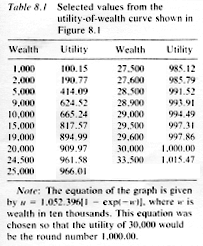
EXAMPLE 8.1 Consider a party for whom the graph of the utility of wealth is as in Figure 8.1 and assume that the party has wealth of 30,000 and faces the 5 percent risk of losing 20,000. Then his level of wealth will be 30,000 with probability 95 percent and 10,000 with probability 5 percent. His expected utility will therefore be 95% x (utility of 30,000) + 5% x (utility of 10,000), or-see Table 8.1-95% x 1,000 + 5% x 665.24 = 950 + 33.26 =983.26. On the other hand, if the party faces the 10 percent risk of losing 10,000, his expected utility will, by similar logic, be 90% x 1,000 + 10% x 909.97 = 900 + 91 = 991, which is higher. (The party's expected utility will be higher still if he loses 1,000 for certain, for then his expected utility will just be the utility of having 29,000, or 994.49.)
This illustrates that a party for whom the graph of the utility of wealth is concave is indeed risk averse.
There are different degrees of risk aversion corresponding to different degrees to which suffering large losses would matter to parties. Formally, the degree of risk aversion depends on the concavity of the graph of utility of wealth: the greater the concavity, the greater the degree of risk aversion (because the greater the rate at which utility losses grow with losses of wealth).(2)
8.1.2 Importance of risk aversion with regard to individuals and firms. The importance of risk aversion will ordinarily depend on the size of risk in relation to an individual's assets and to his needs. Thus it may make sense to think of a person with assets of $10,000 as quite averse to a risk of a $5,000 loss, especially if he will soon want to use (say, for medical or educational purposes) the greater part of his $10,000. But where a person with assets of $300,000 faces a $5,000 risk, risk aversion will likely be an unimportant factor, and it will usually do no harm to consider the person as risk neutral (although risk aversion would probably become relevant if the magnitude of the risk he faced was $200,000).
The attitude toward risk of firms will reflect the attitudes towards risk of their managers, employees, and shareholders. To the extent that the managers and employees of a firm are risk averse and that their rewards (or positions) are tied to the firm's performance, they will want the firm to behave in a risk-averse way. One would therefore expect there to be some tendency for firms to avoid risks jeopardizing their profitability or their assets. However, to the extent that shareholders hold well-diversified portfolios, they will not be much concerned about the risks borne by a firm (since the risks of different firms in a portfolio will tend to cancel one another). Consequently, shareholders will often wish firms to be operated in an approximately risk-neutral manner, and firms will be operated in that way insofar as shareholders exercise control over managers and employees.
8.1.3 Risk aversion, the allocation of risk, and social welfare. The presence of risk-averse parties means that the distribution or allocation of risk will itself affect social welfare. Specifically, and assuming for convenience that social welfare is the sum of parties' expected utilities,(3) the shifting of risks from the risk averse to the risk neutral, or, generally, from the more to the less risk averse will raise social welfare. This is because the bearing of risk by the more risk averse would result in a greater reduction in their expected utility than will the bearing of risk by the less risk averse or by the risk neutral. Indeed, for this reason, it is always possible for the more risk averse to pay the less risk averse or the risk neutral to assume risk, so as to leave both better off in terms of expected utility.(4)
EXAMPLE 8.2 Assume that the risk-averse party of the preceding example initially bears, say, the 10 percent risk of losing 10,000, and consider the situation if he pays 1,000 to a risk-neutral party for him to bear the risk. The risk-averse party will be better off, for it was shown before that his expected utility will be 991 if he bears the risk, yet 994.49 if he pays 1,000 and does not bear it. And the risk-neutral party will be just as well off', since he will be indifferent between not bearing any risk and being paid 1,000 to bear the 10 percent risk of losing 10,000. It is therefore clear that if the risk- averse party pays a little more than 1,000 (say, 1, 100), he will still be better off having shifted the risk (his wealth will be 28,900, so his utility will be 993.91, which is still greater than 991), but now the risk-neutral party will also be better off (by 100) rather than just as well off.
Social welfare is raised not only by the complete shifting of risks from the more to the less risk averse or to the risk neutral, but also by the sharing of risks among risk-averse parties. Sharing risks reduces the magnitude of the potential loss that any one of them might suffer, as is illustrated in the following example.
EXAMPLE 8.3 Suppose that the risk-averse party of Example 8.1 initially bears the 5 percent risk of losing 20,000 and that another, otherwise identical, risk-averse party bears no risk. Then since the expected utility of the first party will be (as was shown) 983.26 and that of the second 1,000, the sum of their expected utilities will be 1983.26. If, however, losses are divided equally between the parties, so that each bears a 5 percent risk of losing only 10,000, then the expected utility of each will be 95% X 1,000 + 5% X 909.97= 995.50. The sum of their expected utilities will thus be 1991, and social welfare will be higher.(5)
Whereas in this example the parties were equally risk averse and an equal sharing of losses was shown to be socially beneficial, some unequal sharing of losses can always be shown to be beneficial where the parties are not equally risk averse.(6) Also, although in this example losses where shared by two parties, social welfare can in theory always be enhanced by bringing additional parties into a risk-sharing agreement (here we ignore the "transaction" costs of so doing), because this further reduce the size of the losses each might face. (Insurance, the subject of the next section, is an important example of beneficial sharing of risk among many parties.)
8.1.4 Remarks on the allocation of risk and social welfare. (1) The proper allocation of risk raises social welfare not only directly, by reducing the risk borne by the risk averse, but also indirectly, by making the risk averse willing to engage in socially desirable, risky activities. Thus, for example, an individual may decide to undertake a promising business venture only because he has partners with whom he can share the risk.
(2) Protection of the risk averse against risk is socially beneficial for reasons quite distinct from those appealing to the desirability of equity in the distribution of wealth. This is apparent, for instance, from the point that two risk averse parties with equal levels of wealth (and therefore about whom there can be no questions concerning lack of distributional equity ) may each be made better off, ex ante, by arranging to share a risk. That there should be a tendency to conflate the issue of distributional equity with that of the allocation of risk is no doubt engendered by the fact that after a party has suffered a loss he will be in a disadvantageous position relative to others in the absence of any risk-bearing agreement.(7)
(3) It should also be emphasized that the allocation of risk is in principle just as important a determinant of social welfare as the production of goods and services or the reduction of accident losses. The impression some may have that the conventional normative economic calculus is concerned only with the latter, "real" elements is incorrect.
8.2 The Theory of Insurance
8.2.1 Assumptions of the theory. Under the arrangement known as insurance, parties referred to as insureds pay premiums to an insurer in exchange for protection against possible future losses. The insurer is obligated to pay insureds an amount specified by an insurance policy if the insureds make claims for losses they suffer.(8)
In the analysis of insurance here it will be assumed that there are many risk averse insureds facing identical, independent risks of loss and that there are essentially no administrative expenses associated with the insurer's operations.(9) This assumption implies that the insurer can be virtually sure of covering its costs by collecting from each insured the expected value of the amount it will have to pay him. If, for instance, each insured faces a 5 percent risk of losing 10,000 and will be paid that amount in the event of a loss under the insurance policy, the insurer can cover its costs by collecting premiums of 500.(10)