| legal reasoning: analogy | |
Criticisms & Defenses of Reasoning by Analogy in Law(52) |
|
Reasoning by analogy and precedent may be criticized
both for failing to achieve the intended goals and for veiling choices under
assertions of found similarities and differences. Thus, nothing in the goals
of securing equality, promoting the rule of law, and achieving decisive judgments
tells us in a given case what similarities and differences are important, or,
for that matter which traits call for comparison. Even when the similarities
are undisputed, their significance or connection to purposes may remain unclear,
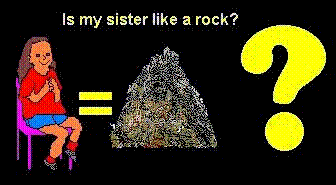
according to critics. "My sister is like a rock"; does this mean she never moves?
Or that she is stable and reliable?(53)
Basically, when a judge or lawyer uses an analogy, it may be with no explanation for why the base case was selected for comparison, or why it was chosen from among competing comparisons. In teaching people to reason by analogy, similar ambiguities appear at the stage of selecting the base case for comparison. People who try to model reasoning by analogy through artificial intelligence computer programs have tried to resolve this problem by quantifying the numbers of similar and dissimilar comparisons, but this fails to capture alternative criteria for selection. Assessing the interaction among factors, the magnitude of similarity or dissimilarity and the overall structural resemblance, each could be candidates for deciding that two cases should be viewed as analogous, yet none is captured by simply counting up the points of similarity.
Some criticize reliance on any analogy that does not look expressly to purposes, and further argue that purposes should not be taken for granted simply because they have been used in the past but instead such stand up to contemporary re-evaluation. Is the underlying premise of the prior case justifiable, today? Are the ends still defensible, and are there better means to achieve them? These questions, pressed recently by Judge Richard Posner, compare analogical reasoning to instrumental or purposive reasoning, and find analogical reasoning wanting; Judge Posner especially criticizes reasoning by analogy for offering no definite content or integrity in the reasoning process.(54)
Posner criticizes the constricted range of values that inform existing judicial precedents in light of a larger range of sources across all of human knowledge could be canvassed. He argues that analogy is inevitable where theory is weak, but rather than rest satisfied with reasoning by analogy, lawyers should develop strong, explicit theories about social consequences of rules and decisions.(55)
Finally, those who emphasize the choices involved in legal and moral judgments attack reasoning by analogy if its users imply that the similarities and differences among cases are simply discovered and thereby determine the outcome for the disputed case.(56) The language of analogical reasoning involves "discovering" or "finding" comparison cases, similarities and dissimilarities. This language itself analogizes legal reasoning to a process of scientific discovery rather than a process for making social choices or for reaching judgments with the influence of political concerns. Especially if the lawyer or judge using an analogy claims the result is compelled, this method of reasoning drapes an aura of false necessity around what should instead be disclosed as a set of alternative choices.
Professor Scott Brewer calls the fans of this quality the "mystics" because they attribute its power to intuition and good training in craft rather than a process of reasoning that can be analyzed and defended.(57)
Brewer quotes Professor (and now Justice of the Massachusetts Supreme Judicial Court) Charles Fried as an exemplar of the mystic supporter of analogy: "Analogy and precedent are the stuff of law because they are the only form of reasoning left when philosophical structures and deductive reasoning give out, overwhelmed by the mass of particular details. Analogy is the application of a trained, disciplined intuition where the manifold of particulars is too extensive to allow our mind to work on it deductively . This is not a denial of a reason; on the contrary; it is a civilized attempt to stretch reason as far as it will go." Id., at 952-3 (quoting Charles Fried, The Artificial Reason of the Law or: What Lawyers Know, 60 Tex. L. Rev. 35, 57 (1981)(citation omitted)). Analogies that seem to compel by linking two cases or images as if they really are similar risk shielding the question of similarity from a test, and risk disguising the power to create what shall count as a precedent or an analogy to the given case.
A brutal example is the Supreme Court's decision in The Antelope.(58) There the Court confronted what should be done with 280 Africans in chains, picked up on the seas by a United States Treasury ship, and claimed by both Spanish and Portuguese slave dealers as their property. Some of the Africans had been seized and some purchased by a Spanish trader; others had survived the wrecking of a Portuguese ship. Should the Africans all be freed, in light of United States law forbidding the importation of new slaves? Or should some or all of them be turned over to the foreign slave dealers? The majority opinion acknowledged that slavery violates human decency and Christian values, but not international laws. The central questions then involved burden of proof in the face of doubts about a) which of the Africans belonged to whom and b) how many Africans had actually been on board each of the ships. Not knowing exactly which slave had been taken from which ship, the Court analogized the problem to one of dividing up goods; it called for reducing the share of the competing parties given deaths of many of the Africans according to a notion of "ratable loss" and approved the use of a lottery to determine which Africans would go to which owners, and which would go free. John Quincy Adams, President during part of this time, later served as defense lawyer for Africans who revolted against and killed their Spanish captors. Looking back on the Supreme Court's decision in The Antelope,(59) Adams concluded the decision had been marked by "heartless sophistry," and manifested decisionmakers whose spirits had been "wedged in thrilling regions of thick-ribbed ice."(60) Thus, with a metaphor did Adams critique the uncritical use of analogy between persons and property.
Can the use of analogy by lawyers be defended against the charges that it does not assure equality or predictability but instead involves many disguised choices as compelled? Can there be an effective response to the charge that reasoning by analogy failed to address directly what purposes should guide analysis and what theory should frame the values and consequences relevant to law? I will offer some defenses, but chiefly in response I will reformulate a role for analogical reasoning. To those who object that analogies seem to compel by implying a real similarity immune from test, it makes sense to concede that analogy partly works precisely by leaping over gaps in knowledge through imagination. But connections once brought into consciousness are not immune from challenge. Doubt is the starting point in using analogy to reason about a problem; the hope is to work from a position of doubt by drawing from what seems familiar and clear. The creative process that helps human beings move from the known to the unknown through comparisons is not a single assertion, but instead a subtle back and forth inquiry.
Aristotle explained how metaphorical language involves the ability to move back and forth between usages and contexts, to transfer oneself into an alien terrain, in an effort to discover manifest or latent resemblances and distinctions. When a lawyer moves back and forth between base of settled law or clear intuition to the target of the disputed case, the process may either align the disputed case clearly with the settled case(61)or may instead cast doubt on the supposed clarity or correctness of the settled case itself.(62)
The richness of the world is matched by the multi-dimensional possibilities of analogies.(63) They allow us to get and hold more strands in our heads at once than do most forms of analytic, instrumental reasoning. They allow us to explore our inchoate intuitions by testing them against a heuristic, a model. It would be a mistake to treat as conclusive the intuitions or flashes of insight that come with comparing a difficult problem with a settled one, but forgoing this source of imaginative problem-solving would abandon a crucial human talent.(64)
This conception actually contains the seed of a response to the charge that analogies neglect explicit discussion of purposes and take the place of strong theories about social consequences and rules. As Professor Cass Sunstein has argued, reasoning by analogy may permit agreement among people who otherwise disagree about purposes or theories; reasoning by analogy may also permit an individual to reach a practical balance or accommodation of multiple purposes or values that conflict within the individual's own mind.(65)
What if we emphasized reasoning by analogy as a creative rather than decision-making process? Rather than pretending to find the analogy that clinches the question about how the treat a disputed case, we could consider how a range of analogies help to illuminate alternative possibilities. The role of analogy in science is instructive here. Scientists often turn to analogies to help reconceive a problem. Science advanced when people started to think of electricity as a current, the atom as like the planets orbiting suns, the circulatory system like a hydraulic pump, the brain like a computer (or in Freud's analogy, an iceberg, with a submerged subconscious), and evolution, like a race with only the fittest reaching the finish line. Thomas Edison's first effort to create a motion picture used a rotating cylinder borrowed from his prior invention, the phonograph. Oncologists resolved to use low-level radiation to surround a destroy a tumor without harming surrounding tissue, after imagining as an analogy a military force surrounding a fortress and bombarding it from every direction.
In each of these examples, the analogy offered no proof but instead a fresh framework to consider. In each, the analogy emerged through imagination, but empirical experimentation and observation followed. As Mary Hesse, a philosopher of science, has suggested, because science cannot work solely through induction or deduction, it requires the help of inventive redescription. "Rationality consists in the continuous adaptation of our language to a continually expanding world, and metaphor is the chief means by which this is accomplished."(66)
Studies of literature identify a range of potential
avenues for analogizing that could begin a toolkit for legal imaginations. Thus,
literature often compares a physical object with a nonphysical one: his conceit
was like a suit of armor. A time period can be compared with something that
is not measured in time: antiquity is the aristocracy of experience. Family
structures offer analogies: "piety and justice are brothers." Exercises in generating
analogies would strengthen an imaginative ability crucial to exploring options
and to communicating them well to others.(67)
| Commonalities in Analogies |
| Contrasts |
|
|
|
|
|
| Relationships |
|
|
|
|
| Instrumental Reason |
|
|
|
The criticism that analogies based on legal precedents unduly confine lawyers' inquiry into values is more aptly a critique of a rigid attachment to a simplistic view of the rule of law. The values of stability, deference to past authority, and predictability have been fairly well-served by the system of judicial precedent, which has also permitted change through time. Whether the current balance between stability and change is optimal deserves discussion, as does the relation between adjudication and legislation, but then the debate properly turns to these societal and institutional questions rather than remaining on the plane of alternative modes of legal reasoning.
Analogical reasoning itself cannot tell its users which comparisons to use or which traits to compare; this critique seems fair. Some cognitive theorists emphasize the importance of higher order syntactic or structural features; others stress the goals and plans of the problem-solving, still others look to surface similarity and structural consistency to explain how an individual uses analogies.(68) Yet when fully and explicitly undertaken, reasoning by analogy calls for defending the selection of the base point for comparison and the similarities and differences identified. The inquiries can indeed push further and question more frequently the norms captured in the precedent or base point. Such questions, if expansive, run up against the ideal of the rule of law , and also the equality principle, of treating likes alike, but if they yield well-reasoned answers, then the quality of legal analysis could improve.
Disguising choice is not a necessary feature of reasoning by analogy. An earlier generation of lawyers and judges proceeded with analogies as if no choices were involved and thus may themselves have felt convinced that the analogies they used reflected real similarities rather than choices about what to view as similar. Another generation may eagerly and insistently expose the choices and demand justifications beyond the initial offering of analogies and precedents.
In the meantime, how would you approach an unprecedented problem, one that has no obvious legal referent? Take a libel suit against a computer bulletin board. We can and we should think about the consequences for free speech and distributed harms from ruling for or against the liability. It may also help to sharpen our thinking to generate some analogies. The bulletin board operator is like a publisher who selects what should be published. Instead, the bulletin board operator is like a telegraph operator who send on whatever customers provide. Your intuitions may shift and grow more clear as you consult these and other analogies. Which ones can you imagine?
Here is one more problem to consider: what should determine the level of quality to which a seller must be held when engaging in commerce?(69) Laws governing the sale of goods by a merchant have long imputed a warranty of merchantability: the good must be "fit for the ordinary purposes for which such goods are used."(70) Could, and should, this notion provide an analogy when the question of quality involves the rendering of professional services, such as medical services?(71)What if the question of quality concerns the apartment rented by a landlord?(72)Or if the question of quality involves a builder selling a new home?(73) Or, finally, what should set the level of quality when a private homeowner --not a regular seller in the field -- sells his old home to a buyer?(74) Notice how these instances depart from the original example in their contexts, and how this last instance departs from the others because it does not involve a regular merchant or seller. Under existing case law, courts have applied a negligence standard to the provision of professional services, and a "buyer beware" standard for the typical sale of an existing home, but courts have appealed to the warranty of merchantability in the sale of goods to establish a similar warranty of habitability in the rental of an apartment. When you compare the instances, what elements matter and what implicit purposes? What other arguments, alongside reasoning by analogy, would you want to include when trying to persuade a court to your view?