| legal
reasoning: analogy |
How Reasoning By Analogy Works in Law
|
|
Reasoning by analogy works by inferring from the
recognition that two items share some traits that they share an additional trait
that one of them is known to possess or by judging that because two items share
some traits they should be characterized or treated in a similar way.(7)
To be persuasive, the comparison must appeal to a sense or intuition that the
additional trait is likely to accompany the existing traits, or that it would
be wise to treat the two items similarly on the issue in dispute. Edward Levi's
classic book, An Introduction to Legal Reasoning(8)uses
the history of common law cases that address what kinds of objects are inherently
dangerous to demonstrate a process of reasoning by example. He traces a historical
line of cases that address when tort liability should fall on manufacturers
for injuries their products cause. This history illuminates reasoning by analogy
as one of the central methods in developing the common law. Judges ask questions,
such as, given a case deciding that a train is inherently dangerous, but a wagon
is not, how should a car be viewed?
The comparison may appear to proceed at a fairly
concrete level. (9)If
we compare the physical qualities of the car with the train and the wagon, the
car may seem more like the train given both are made of metal rather than wood.
The car may seem more like the wagon in that each has only four wheels and span
about the same length. The train, on the other hand, has an engine that pulls
multiple cars. Yet even such concrete comparisons presuppose some relevant normative
force or principle. Thus, the common law judge may intuit that vehicles that
are subject to less physical control should be more carefully regulated by law;
the train pulling multiple cars is inherently dangerous because there is relatively
less control over its motion than there is over a single wagon -- and an automobile
is more like the wagon in this respect. Alternatively, the train is inherently
dangerous because it moves so quickly and can cause such damage upon impact
with a stationary object or person; the auto is more like the train than the
horse-drawn wagon in this respect and should be treated the same way.
(9)If
we compare the physical qualities of the car with the train and the wagon, the
car may seem more like the train given both are made of metal rather than wood.
The car may seem more like the wagon in that each has only four wheels and span
about the same length. The train, on the other hand, has an engine that pulls
multiple cars. Yet even such concrete comparisons presuppose some relevant normative
force or principle. Thus, the common law judge may intuit that vehicles that
are subject to less physical control should be more carefully regulated by law;
the train pulling multiple cars is inherently dangerous because there is relatively
less control over its motion than there is over a single wagon -- and an automobile
is more like the wagon in this respect. Alternatively, the train is inherently
dangerous because it moves so quickly and can cause such damage upon impact
with a stationary object or person; the auto is more like the train than the
horse-drawn wagon in this respect and should be treated the same way.
The comparison explicitly may pursue more functional
or sociological lines. Who uses the car, who controls it, and how does that
compare with who uses and controls the train and the wagon? The comparison may
invite predictions about risks of injuries from each vehicle or risks of fatal
injuries from each; the chance of harm and the scope of harm are related but
distinct concerns. The comparison might direct an inquiry into the social relations
that surround the vehicles: what are the dealings between manufacturer, seller,
operator, and victim for each, and who in each circumstance has most control
over the risk of accidents? Again, implicitly, these comparisons point back
to some norms about how to allocate risks, assess harms, and produce incentives
for care or for redistribution of the costs of accidents.
Thus, implicitly many of these comparisons direct
attention to the purposes of the rule. One rule would state, "Producers of dangerous
objects should bear the costs of accidents involving them." This rule might
serve the purpose of giving produces incentives to reduce the risks or might
instead advance the goal of spreading the costs of accidents through the prices
the producers can set for the objects. A contrasting rule would indicate: absent
a special danger, a producer should face liability only for negligent failures
of care, not strict liability for any damage resulting from use of the product.
This rule might serve the purpose of promoting greater caution by consumers,
more investment in new products, reducing the price of new products, or allowing
greater freedom for producers. Yet rather than trying directly to fit the new
case -- the car accident -- under an already articulated rule and one or more
of its purposes, reasoning by analogy proceeds, at least for a while, by comparisons
with instances that have, and have not, fallen under the rule in the past. In
this way, reasoning by analogy can bring to mind and allow simultaneous consideration
of more than one purpose, or a purpose and a social practice, or a purpose and
a prediction of how the world operates. Juggling elements with the template
of a comparative example helps prompt intuitions about their sensible bearing
on the contested situation.
Examples
of Analogical Reasoning in Judicial Opinions
Notable case law examples of reasoning by analogy
appear in influential judicial opinions. Consider these examples from contracts,
torts, property, criminal law, civil procedure, and constitutional law:
1. Contracts
In Frigaliment v. B.N.S. Int'l Sales(10)
a buyer sued a seller of chickens after entering into two contracts; one called
for a certain quantity of heavier chickens, at a lower price, and the other called
for the delivery of a certain quantity of lighter weight chicken at a higher price.
Younger, tastier chicken could come in either weight while older, less tasty chicken
came only in the heavier weight. The seller had sent the buyer both younger and
older chickens. The buyer sued, claiming the contract was for only younger chickens.
In his opinion for the court, Judge Henry Friendly offered this analogy: "Plaintiff
says the [lighter] birds necessarily had to be younger chicken since the older
birds do not come in that size, hence the [heavier] birds must likewise be young.
This is unpersuasive -- a contract for 'apples' of two different sizes could be
filled with different kinds of apples even though only one species came in both
sizes." (11)
2. Torts
In Adams v. New Jersey Steamboat Co.,(12)
a steamboat passenger sued the owner after the theft of valuables from the rented
cabin; neither passenger nor owner had been negligent. The passenger claimed the
owner nonetheless was strictly responsible, regardless of any failure or compliance
with care, in light of prior case ruling that innkeepers were strictly liable
for the theft of boarders' valuables. The owner argued against strict liability
and pointed to precedents rejecting liability claims by passengers on open-berth
sleeping trains. For purposes of liability for theft from a passenger, should
the steamboat owner be viewed as more like the innkeeper or more like the train
owner? The court reasoned that "A steamer carrying passengers upon the water,
and furnishing them with rooms and entertainment, is, for all practical purposes,
a floating inn, and hence the duties which the proprietors owe to the passengers
in their charge ought to be the same."(13)
The court noted that both innkeepers and steamboat operators are entrusted with
high levels of confidence in the face of temptations by many to endanger guests.
Given this parallel relationship to guests, innkeepers and steamboat operators
should bear the same kinds of duties to guests.(14)
3. Property
Is the income-enhancement value of a professional
degree the kind of property interest covered by a statutory rule of equal division
of the partners' property upon divorce? The New York Supreme Court answered affirmatively
in O'Brien v. O'Brien,(15)
after analogizing the license to practice medicine to unmatured pension rights.
Both represent expected streams of earnings; both would have contributed to the
economic partnership of an ongoing marriage; both, reasoned the court, should
be part of the economic pool available to both spouses if the marriage ends.(16)
4. Criminal
Law(17)
The Supreme Court had applied the Fourth amendment's
requirement of a warrant before a police search or seizure to searches of a house
but not to searches of a car. In California v. Carney,(18)
the Court faced the question of whether the warrant requirement applied to a motor
home parked off the street. Here the Court had two alternative cases for reasoning
by analogy, and thus asked whether the motor home was relevantly more like a house
or more like a car. The Court considered reasons for exempting car searches from
the warrant requirement: ready mobility, a lower expectation of privacy, pervasive
regulation of public highways, and concluded that these also applied to the mobile
home. In this instance, use of analogy visibly prompted elaboration of reasons
supporting the settled case to help align the disputed case of mobile homes with
the treatment of cars.(19)
5. Civil
Procedure
The doctrine of res judicata -- claim preclusion
-- directs that a judgment on the merits of a controversy bars subsequent actions
between the same parties upon the same claim. Discerning what suits should be
precluded often engages courts and parties in analogical reasoning. For example,
when a plaintiff filed suit against the state and alleged a due process violation
in his termination from public employment, the court found his claim barred in
light of his previous filing of a similar claim in a court which ruled that his
remedy lay entirely within the state agency handling unfair labor practices.(20)
The state court found persuasive an analogy to a prior case in which the plaintiff's
claim arose from the termination of his worker's compensation benefits; in both
cases, the proper relief was available before a state agency and a prior court
decision had said so.
6. Constitutional Law
In Bowers v. Hardwick,(21)
the Court analogized prosecution for consensual adult sodomy in the home to prosecution
for possession of illegal drugs in the home. The Court reasoned that just as the
sheer fact that the proscribed conduct occurs in the home would not bar prosecution
for drug possession, neither should the occurrence of sodomy in the home bar prosecution.
The Supreme Court considered in Tinker v. Des Moines Independent School District,(22)
whether the First Amendment could countenance a decision by school officials to
forbid the wearing of armbands by student to protest the Vietnam War.(23)In
the Court's opinion, upholding the students' First Amendment freedoms, the Court
analogized the restriction to a hypothetical school regulation "forbidding discussion
of the Vietnam conflict, or the expression by any student opposition to it anywhere
on school property except as part of a prescribed classroom exercise" which would
violate students' rights of free expression(24)
Lawyers and judges frequently use analogies during
oral argument. Consider this example
from a law school moot court argument before Justice Steven Breyer over
whether a court in one state could exercise personal jurisdiction over the sender
of an electronic mail transmission in another state.

Analogical
Reasoning & Interpretation of General Rules
The same process of reasoning by analogy is commonly
used by lawyers in interpreting not only cases, but also statutes, and other general
rules announced in advance. Consider this example: A municipal ordinance states
"Any person who brings a vehicle into the public park shall be fined $100.00."
The ordinance was applied against a person who rode a motorcycle into the park.
Should it apply now, by analogy, to a person who rides a skateboard through the
park? Another who walks a bicycle through the park? A third who uses a wheelchair
in the park? An electric wheelchair? Another who drives an ambulance in the park
to respond to an emergency? Again, the process of comparing the new situations
to the one already yielding a decision can call for physical comparisons, functional
ones, sociological, or purposive ones.(25)
All these examples suggest the ways that common
law development and statutory interpretation both pursue the equality norm --
treating like cases alike. Both also aspire to the ideal of the rule of law
while producing actual decisions in hard cases. This means that lawyers and
judges reason case-by-case and interpret general rules not just to achieve good
results specific to each occasion but also to produce and sustain predictable
governance that puts people on notice in advance of the consequences of their
actions. These goals could be jeopardized if analogical "reasoning" was just
a kind of Gestalt response to the particulars of each case. To serve the goals
of good results and fair notice, analogical reasoning, especially as part of
system of precedent, must and does make implicit reference to norms that themselves
can undergo clarification and refinement through application.
Literary
Analogies and Metaphors
Analogies, quite apart from precedents, also inform
legal reasoning and supply rhetorical force in lawyers' arguments and judicial
opinions. Sometimes, a lawyer may try to use a global analogy to take the entire
legal situation and compare it with a nonlegal one in order to elicit sympathies
from the decision maker. Literary theorist Wayne Booth was so struck by this analogy,
used by a lawyer, that he used it in an essay on rhetoric:
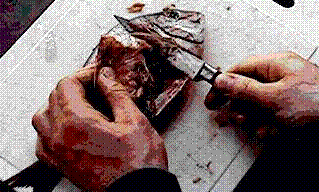
"A lawyer friend of mind was hired to defend a
large Southern utility against a suit by a small one, and he thought at first
that he was doing fine. All of the law seemed to be on his side, and he felt
that he had presented his case well. Then the lawyer for the small utility said,
speaking to the jury, almost as if incidentally to his legal case, "So now we
see what it is. They got us where they want us. They holding us up with one
hand, their good sharp fishin' knife in the other, and they sayin,' 'you jes
set still, little catfish, we're jes going to gut ya.'" At that
moment my friend reports, he knew he had lost the case."(26)
 Actually, this comparison is offered as a metaphor,
a condensed analogy that skips the step of the explicit comparison and simply
treats the two instances as identical. Rendered as an analogy, the lawyer's
point would be: "the large utility is to the fisherman as the small utility
is to the catfish" and "the knife is to the catfish's vitality as the large
utility's conduct is to the small utility's vitality."
Actually, this comparison is offered as a metaphor,
a condensed analogy that skips the step of the explicit comparison and simply
treats the two instances as identical. Rendered as an analogy, the lawyer's
point would be: "the large utility is to the fisherman as the small utility
is to the catfish" and "the knife is to the catfish's vitality as the large
utility's conduct is to the small utility's vitality."
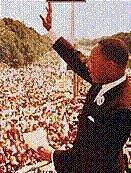 Dr. Martin Luther King
In his famous "Letter
from a Birmingham Jail" Reverend Martin Luther King, Jr. responded with
analogies to charges that his civil rights effort should cease because it caused
violent reactions: "In your statement you assert that our actions, even though
peaceful, must be condemned because they precipitate violence. But is this a
logical assertion? Isn't this like condemning a robbed man because his possession
of money precipitated the evil act of robbery? Isn't this like condemning Socrates
because his unswerving commitment to truth and his philosophical inquiries precipitated
the act by the misguided populace in which they made him drink hemlock? Isn't
this like condemning Jesus because his unique God-consciousness and never-ceasing
devotion to God's will precipitated the evil act of crucifixion? We must come
to see that, as the federal courts have consistently affirmed, it is wrong to
urge an individual to cease his efforts to gain his basic constitutional rights
because the quest may precipitate violence. Society must protect the robbed
and punish the robber."(27)
Lawyers and judges often use similes, metaphors,
and other figures of speech to give a more immediate and vivid feel to what
would more fully be expressed as an analogy. Oliver Wendell Holmes, Jr., once
compared the property doctrine of adverse possession as an effort to protect
the expectations of someone who has occupied another's land for a long time
and who thus has come to be "like a tree in a cleft of a rock [which] gradually
shapes his roots to his surroundings, and when the roots have grown to a certain
size, cannot be displaced without cutting at his life." (28)
"Juliet is the Sun," Romeo tell us, and we see then how a loved one can be the
center of one's life.(29)
Of course, you may think instead that this metaphor means that Juliet lights
up Romeo's life, or that he finds her distant, or hot; these kinds of ambiguities
are part of the territory that comes with metaphors.
Sometimes, despite or even because of its ambiguity,
the simile or metaphor seems to do even more of the work of reasoning, or prompting
recognition of factors or values that should matter. Thus, in an influential
opinion, one federal court developed the metaphor connecting the executive headquarters
of a corporation and the "nerve center" of an organism to help fix the location
of the corporation's principal place of business for purposes of diversity jurisdiction.(30)
"Where a corporation is engaged in far-flung and varied activities which are
carried on in different states, its principal place of business is the nerve
center from which it radiates out to its constituent parts and from which its
officers direct, control, and coordinate all activities without regard to locale,
in the furtherance of the corporate objective."(31)
When asked to treat automatic vending machines as retail stores to satisfy the
"retail establishment" exemption to federal fair labor standards, a federal
court refused with this reasoning:
"The individual automatic vending machines cannot
be realistically likened to independent retail stores. They are rather silent
and automatic salesmen offering at retail the goods of a single enterprise....'The
machine is the mechanical arm of the operator who sells directly to the customer.'"(32)
The
Steps of Analogical Reasoning
In each of the contexts of case reasoning, statutory
interpretation, and global rhetorical comparisons, analogies operate through
three basic steps, all responding to a sense of doubt or uncertainty about a
how to treat or view an instance or problem.(33)
| How to Construct
an Analogy |
| Step
1: |
Articulate a proper base point for comparison
with the instance in dispute.
|
| Step
2: |
Identify similarities and differences
between the base point and the disputed instance.
|
| Step
3: |
Determine whether to treat the two instances
the same because the similarities outweigh the differences or to distinguish
them because the differences prevail.
|
The first step is identifying a proper base or example
as the point for comparison with the instance in dispute. This base point could
be a judicial precedent, a prior instance of statutory interpretation, or an example
from common sense or lay understanding. Finding this point of comparison may involve
a flash of insight, or instead a deliberative review of a range of potentially
relevant sources for drawing comparisons with the disputed instance. The second
step is to identify the relevant similarities and differences between the base
point and the disputed instance. The third involves determining whether the similarities
are sufficiently greater than the differences to treat the two instances the same
or to instead distinguish them.(34)
For some people, the second step and the third step are identical. Finding the
similarities and differences, to them, determines the conclusion about how to
treat the disputed instance. Yet, this  approach
would better describe "identities" than analogies; that is, circumstances that
actually are identical. Where analogy makes a contribution is where the disputed
instance actually differs in some noticeable and worrisome way from the comparison
point. Recent work in cognitive theory suggests that analogical reasoning is an
instance of problem-solving methods that match patterns in the environment with
stored schemas for solutions or solution procedures.(36)
approach
would better describe "identities" than analogies; that is, circumstances that
actually are identical. Where analogy makes a contribution is where the disputed
instance actually differs in some noticeable and worrisome way from the comparison
point. Recent work in cognitive theory suggests that analogical reasoning is an
instance of problem-solving methods that match patterns in the environment with
stored schemas for solutions or solution procedures.(36)
Reasoning
by Disanalogy
The three steps of 1) locating a base for comparison;
2) identifying similarities and differences between the base and the disputed
instance; and 3) determining whether the similarities are more weighty than the
differences are also used in the process of reasoning by disanalogy. Here the
base point is used to demonstrate why the disputed instance is sufficiently different
to warrant treatment different than that accorded to the base point. Consider
this in the context of inherently dangerous objects. Let's assume that a gun has
already been treated as an inherently dangerous object. Should a lamp that exploded
be treated similarly as an inherently dangerous object? Perhaps we note that the
gun was designed to injure while the lamp was not.
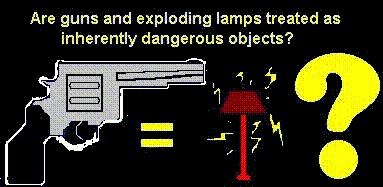
Perhaps this helps us to realize that this element
-- being designed to inflict harm -- is crucial to the conclusion that the gun
should be treated as inherently dangerous, thus exposing its manufacturer to
a strict duty for injuries the gun causes. The absence of this element -- the
lamp was not designed to inflict harm -- suggests that the producer of the lamp
should not be treated as strictly liable for injuries the lamp may cause. Reasoning
in this way may imply a continuum that starts with the precedent or obvious
case, then moves away towards a less similar case and then continues on toward
one that is clearly different.(37)
Perhaps a lighter is a middle-case, somewhere between the gun and the lamp,
on the precise dimension of "designed to produce harm." The lighter was designed
to produce fire, which can harm, but the lighter itself was intended not to
harm but to enable easy igniting.
Distinguishing a proffered analogy involves emphasizing
a difference; sometimes, the reasoning by disanalogy helps illuminate a trait
in the base or settled example that was not previously emphasized but now seems
crucial, given its contrast with the contested case. Here is an example from
contracts; other examples of reasoning by disanalogy can easily be found, for
example, in property, and civil procedure.(38)
1. Contracts
In Mills v. Wyman,(39)
the court addressed whether a father was obliged to repay a "good Samaritan" for
expenses incurred in caring for the father's son when the son was near death.
The father promised to make this payment but made the promise after the services
were rendered. Some precedents indicated that no promise is legally enforceable
if made after the fact of the proffered services; others in contrast, suggested
that moral consideration could count as a basis for enforcing such a promise.
On further review, the court in Mills(40)
found that all the cases treating moral consideration as adequate to enforce a
promise involved prior "valid" consideration that had been extinguished by law,
such as a legally enforceable promise to pay a debt that had been extinguished
by discharge in bankruptcy. No enforceable promise remained and yet the moral
obligation could supply the missing element. But the father in Mills(41)
had no such prior but now extinguished consideration; on this basis, the precedents
favoring enforcement could be distinguished as disanalogous. They included a crucial
trait missing in this case.(42)
2. Property
In Moore v. Regents of the University of California,(43)
the plaintiff claimed that his physician, hospital, a researcher, a research firm,
and a pharmaceutical company made use in their own profitable venture, without
his permission, of cells removed from his body in the course of medical treatment.
The plaintiff argued that the defendants therefore wrongly appropriated something
that belonged to the plaintiff.(44)The
plaintiff argued that he had a proprietary interest in his own genetic material
the same way the courts have recognized the proprietary interest each person has
in his own likeness. The majority rejected this analogy, however, on the grounds
that one's likeness is unique but one's genetic material for producing lymphokines
are identical in all people: "it is no more unique to Moore than the number of
vertebrae in the spine or the chemical formula of hemoglobin."(45)
3. Civil Procedure
Personal jurisdiction, governed by the due process
clauses, limits judicial power to defendants who have "minimum contacts" with
the forum state, with the further limitation that the exercise of jurisdiction
must be compatible with traditional notions of fair play and substantial justice.(46)
Application of this test in practice often engages courts in drawing analogies
and disanalogies with the fact patterns of prior cases. Thus, in Calder v.
Jones,(47)
the Supreme Court faced whether a state court in California could exercise jurisdiction
over the editor and reporter for the National Enquirer after the entertainer
Shirley Jones sued them for libel. Although 12% of the paper's circulation occurs
in California, the reporter and editor were Florida residents who had taken no
California trips related to the story in question. The Court considered but rejected
the defendants' effort to analogize their situation to the situation of "a welder
employed in Florida who works on a boiler which subsequently explodes in California."(48)
Just as the welder would have no control over nor derive any direct benefit from
his employer's sales in a distant state, the editor and reporter would have no
control nor derive any direct benefit from sales in California -- and thus should
not be subject to jurisdiction there. Justice Rehnquist distinguished this hypothetical
by emphasizing how the welder would at most face a negligence claim, while the
editor and reporter faced a claim of an intentional tortious action with the brunt
of the injury falling on the plaintiff, who resided in California; the defendants,
therefore, had to submit to personal jurisdiction as primary participants in the
alleged wrongdoing intentionally directed at a California resident. Thus, reasoning
by disanalogy often exposes the absence in the disputed case of a trait present
in the prior case -- but not previously the focus of attention or analysis.
For both disanalogies and analogies, the process
of comparison typically involves comparing relationships. The qualities of a
given object seem similar enough to the qualities of another object that is
treated as inherently dangerous such that the first object should also be treated
as inherently dangerous. The welder lacks a kind of intention that the journalist
has when producing a product and sending it into commerce. The wheelchair differs
enough from the motorcycle such that it should not carry with it the same penalty
for entrance into the public park. A dominant mode of reasoning by disanalogy
looks to factual traits in relation to a (frequently implicit) purpose pursued
by the decisionmaker or manifest in the relevant norm; a fact present in the
disputed instance but absent in the precedent makes it apparent that the purposes
in the precedent would not be advanced by applying them to the disputed instance.
Looking to purposes often reveals the possibility
of multiple lines of similarity or difference, affected chiefly by the purpose
for which the reasoner pursues the comparison. The children's television show,
"Sesame Street®," teaches the basic process of drawing comparisons and adds
this lesson about purposes.
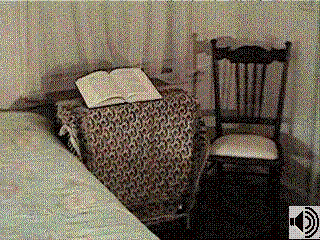
Set to music is the song,
"Which one of these things is not like the other?" Displayed are a book, a table,
a bed, and a chair. The book differs from the table, bed, and chair -- if the
purpose is identifying furniture or things with feet. But the bed differs from
the book, chair, and table if the purpose is selecting what a student needs
for studying.(49)
Similarly, cognitive scientist Douglas Hofstadter
offers two analogies for thinking about DNA: "The first is an analogy between
DNA and a zipper. When we are presented with this analogy, the image of DNA
that comes to mind is that of two strands of paired nucleotides (which can come
apart like a zipper for the purposes of replication). The second analogy involves
comparing DNA to the source code (i.e., nonexecutable high-level code) of a
computer program. What comes to mind now is the fact that information in the
DNA gets 'compiled' (via processes of transcription and translation) into enzymes,
which correspond to the machine code."(50)One
analogy highlights the method of replication, the other highlights the process
of containing and transmitting information; each analogy puts together function
and structure in rich and complex ways.
Comparison of two or more situations, by analogy,
permits illumination of the plural features of the world perceived by human
beings. The comparison allows each person to consider the effects of different
constellations of features. Often, legal questions touch upon multiple and inconsistent
purposes; reasoning by analogy permits comparison along several lines without
requiring a resolution at the level of abstract and conflicting purposes.(51)